
North Sulawesi babirusa
Babyrousa celebensis
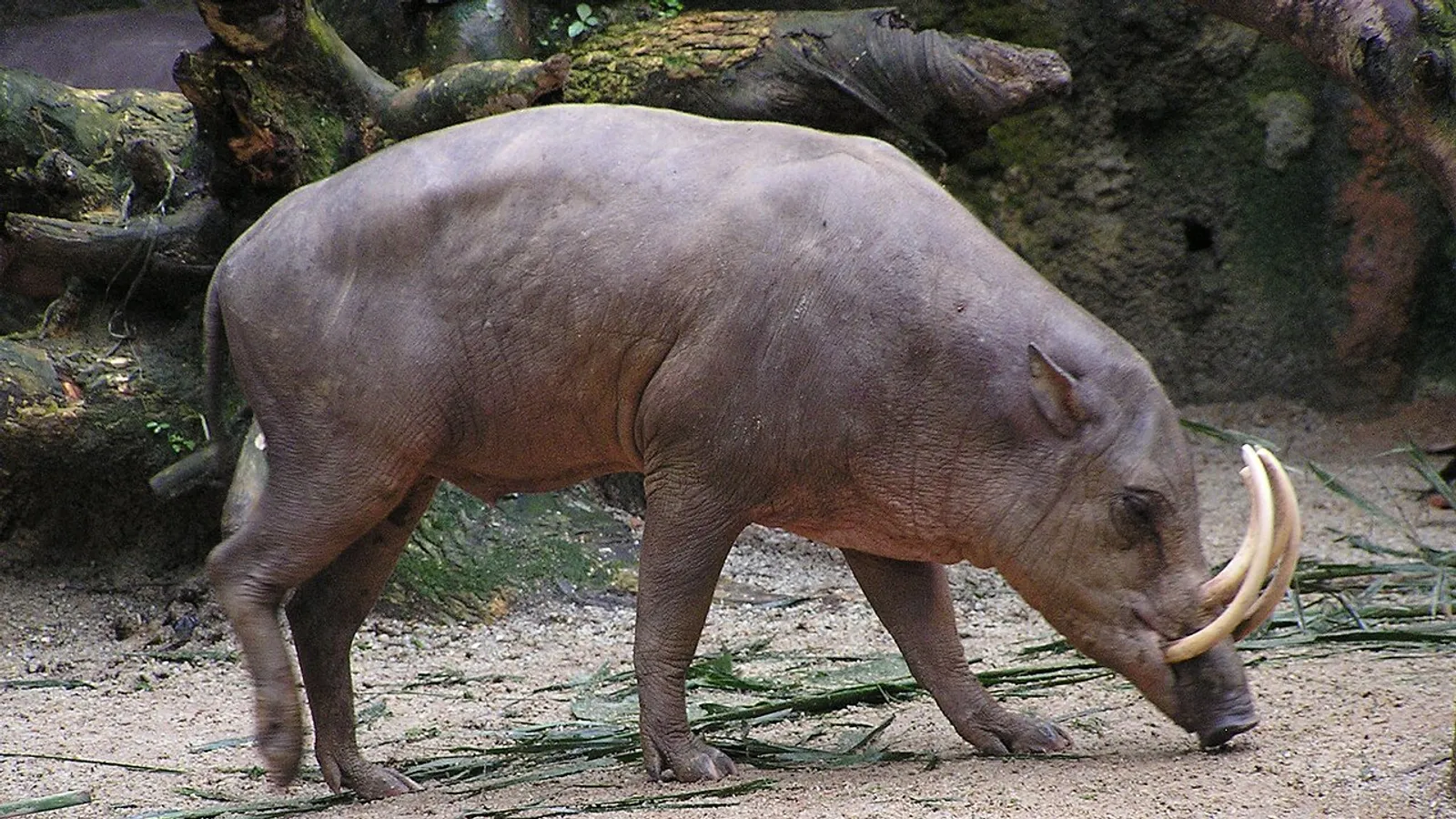
— Where the name comes from
From the Malay babi, “pig”, and rusa, “deer”: “pig-deer”, because the male’s curved tusks, seen from a distance, look like antlers. Celebensis points to Celebes, the old name of Sulawesi. It is one of the rare cases in which the scientific name has adopted the local metaphor instead of replacing it with a Greek compound — and the metaphor is more precise than it seems, because those tusks are not for biting.
— Facts
- Group
- Mammals · Mammalia
- Order
- Even-toed ungulates
- Habitat
- Tropical rainforest, reedbeds, river and lake shores
- Range
- Endemic to Sulawesi, in Indonesia, and to a few nearby islands
- Size
- 85–110 cm of body, 43–100 kg
- Diet
- Omnivore — fruit, leaves, fungi, invertebrates, clay
- Lifespan
- 10 years in the wild, over 24 in captivity
— Characteristics
- 01
The male’s upper canines pierce the muzzle from inside and grow upwards.
- 02
It lacks the reinforced snout of other pigs: it digs little and chews a great deal.
- 03
It has a complex, almost ruminant stomach, unique among pigs.
— What sets it apart
The male’s upper tusks do not come out of the mouth: they pierce the roof of the snout and grow upwards, curving back towards the forehead. If the animal lives long enough and does not wear them down, they can curve round until they re-enter the skull — and in theory kill it. No other mammal has teeth that grow through its own face. What they are for is unclear: they are too fragile for fighting, and the leading idea is that they are simply a signal, visible proof that their bearer has survived long enough to grow them.
