
Olive baboon
Papio anubis
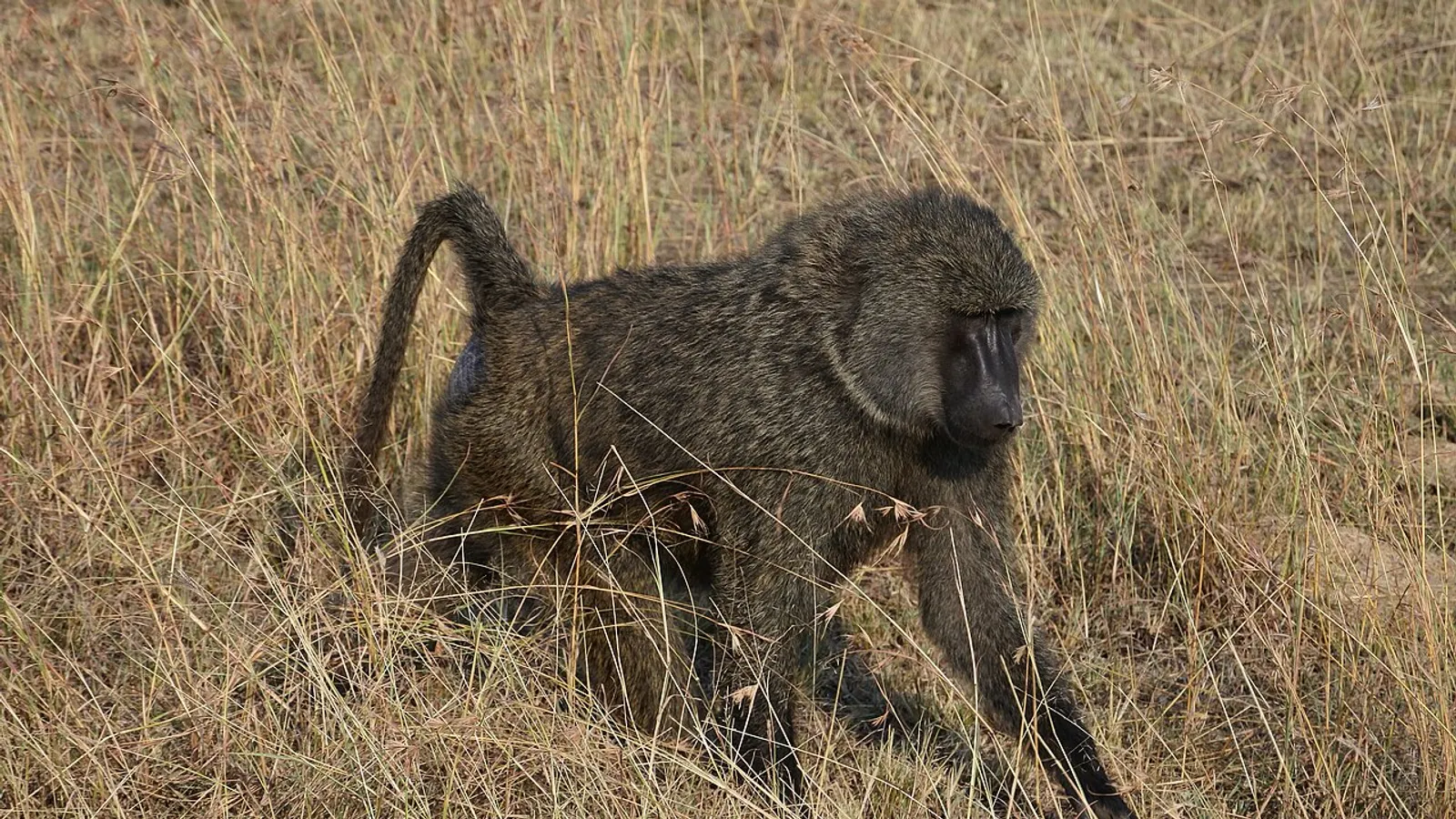
— Where the name comes from
Papio is the New Latin name for the baboon, arrived by way of the French papion. The epithet anubis recalls Anubis, the Egyptian god with a dog’s head: the long, tapered muzzle of this primate seemed to zoologists to evoke the face of the jackal god. The common name “baboon” goes back to the French babouin, perhaps linked to babine, “drooping lip”, while “olive” describes the grey-green tint of the coat.
— Facts
- Group
- Mammals · Mammalia
- Order
- Primates
- Habitat
- Savannah, steppe and open forest.
- Range
- A broad band of equatorial Africa, from Mali and Guinea in the west to Ethiopia and Tanzania in the east.
- Size
- 60–70 cm (head-body), 14–25 kg; males almost twice the size of females
- Diet
- Omnivore — grasses, roots, fruit, insects and small vertebrates
- Lifespan
- 20–30 years in the wild, up to 40 in captivity
— Characteristics
- 01
It lives in large social groups, sometimes over a hundred strong, held together by shifting hierarchies.
- 02
The dog-like muzzle that gives it its name arms the males with canines longer than a leopard’s.
- 03
It is the baboon with the widest range, present in more than twenty-five African countries.
— What sets it apart
A troop of olive baboons studied by the neurobiologist Robert Sapolsky, the so-called “Forest Troop”, lost its most aggressive males to tuberculosis: they had monopolised an infected rubbish tip at a tourist lodge. An unusually peaceable culture then took hold in the group, and was passed on even to males who immigrated years later. It is one of the rare field demonstrations that a primate’s social temperament can be transmitted by learning, and not by instinct alone.
