
Aye-aye
Daubentonia madagascariensis
— Where the name comes from
Daubentonia honours Louis-Jean-Marie Daubenton, the French naturalist and collaborator of Buffon, to whom Étienne Geoffroy Saint-Hilaire dedicated the genus in 1795; madagascariensis simply names the island that holds it. The origin of “aye-aye” is still argued: some take it for an imitation of the animal’s call, others read in it a Malagasy cry of alarm, perhaps a way of not saying the name of a creature held to be an ill omen. The first naturalist to classify it, in 1788, took it for a squirrel and named it Sciurus madagascariensis: it took decades to recognise a primate in that apparent rodent.
— Facts
- Group
- Mammals · Mammalia
- Order
- Primates
- Habitat
- Rainforest and deciduous woodland, out to coconut and clove plantations
- Range
- Madagascar, chiefly along the eastern and northern belt, with fragmented populations in the west
- Size
- 30–40 cm of body plus 44–53 cm of tail, 2–3 kg
- Diet
- Omnivore — wood-boring grubs prised from timber, ramy seeds, nectar, fruit and fungi
- Lifespan
- About 20 years in captivity, presumably less in the wild
— Characteristics
- 01
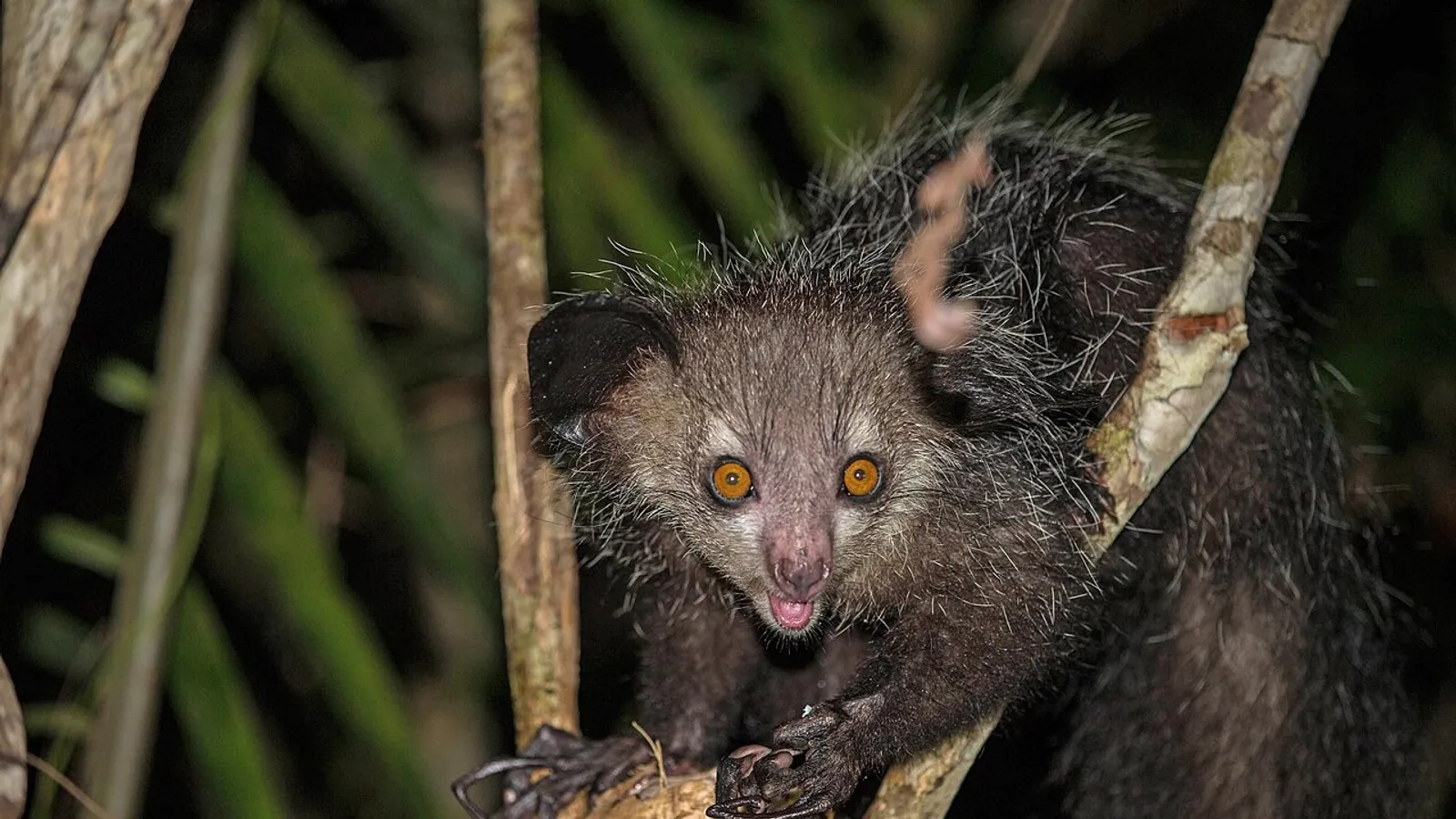
The third finger of the hand is skeletal and extremely mobile, with a ball-and-socket joint unique among primates.
- 02
The incisors grow continuously like a rodent’s, a trait no other primate has.
- 03
The membranous, steerable ears are the instrument with which it locates prey hidden in wood.
— What sets it apart
The aye-aye hunts by tapping: it drums on the bark with its middle finger, up to eight strikes a second, and listens to the resonance of the wood to find the cavities hollowed out by grubs. Having located the gallery, it gnaws the opening with its incisors and slips the finger in like a hook to pull out the prey. It is a foraging technique that on the mainland belongs to woodpeckers, and which here a nocturnal primate has reinvented from scratch. In Madagascar that same bony hand is its undoing: local fady holds that the aye-aye points out with its finger whoever is to die, and for generations it has been killed on sight.
