
Eurasian scops owl
Otus scops
— Where the name comes from
Otus comes from the Greek ōtós, the ear, for the tufts of feathers that are not ears but look like them; scops is skṓps, the name Aristotle gave a small owl, related to the verb “to watch”. The Italian name derives from both by way of the Latin asio. Across half of Italy, though, it is called chiù, which is its call, and under that name it entered Italian poetry through Pascoli.
— Facts
- Group
- Birds · Aves
- Order
- Owls
- Habitat
- Olive groves, tree lines, gardens, wooded farmland, open woods
- Range
- Southern Europe, North Africa, western Asia; winters in the Sahel
- Size
- 19–21 cm, wingspan 47–54 cm, 60–135 g
- Diet
- Large insects, chiefly crickets and grasshoppers
- Lifespan
- 6 years in the wild
— Characteristics
- 01
It is the smallest European owl: it weighs about as much as a blackbird.
- 02
The song is a single whistle repeated every two or three seconds all night.
- 03
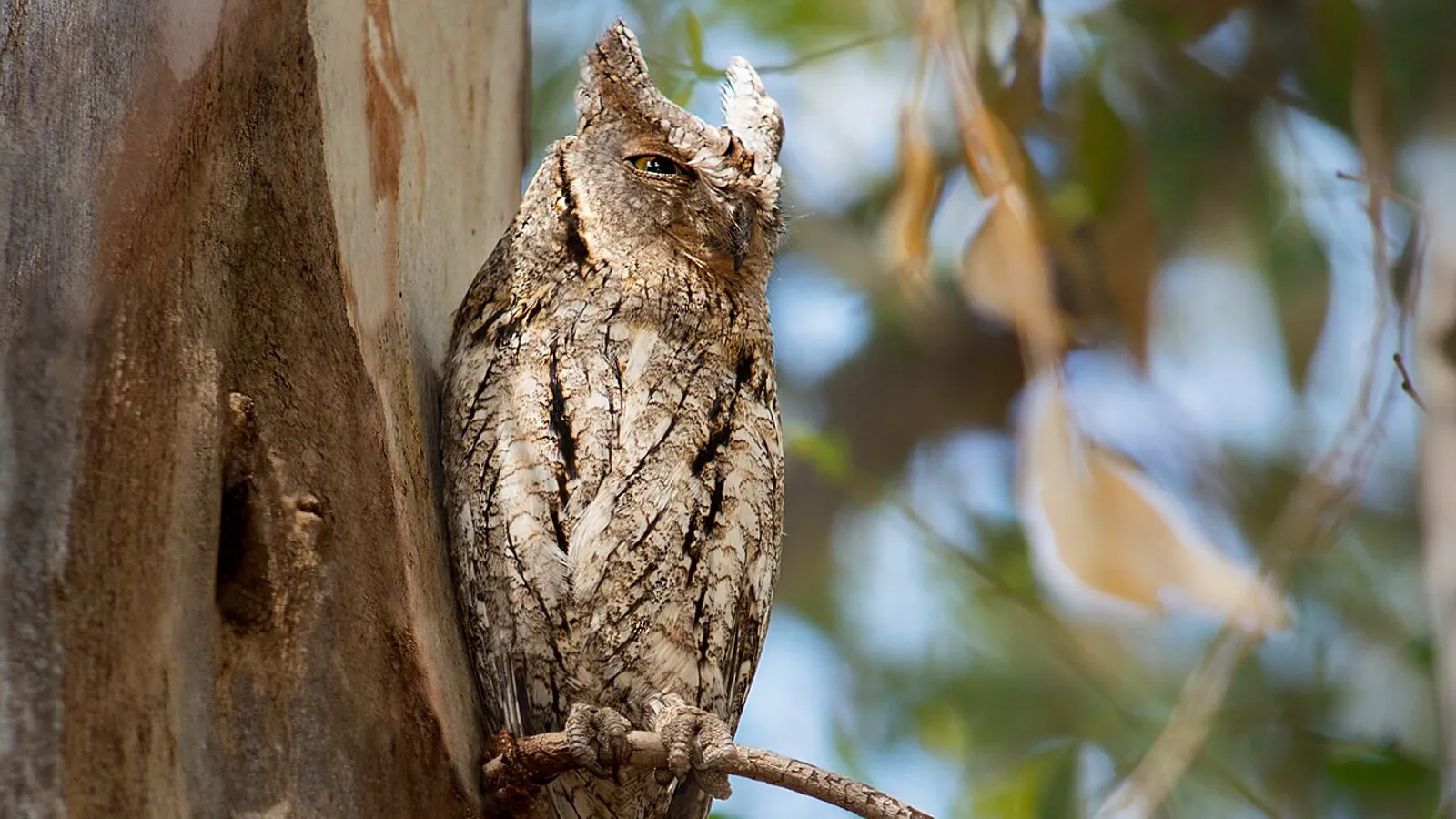
Stretched against a trunk it becomes indistinguishable from the bark.
— What sets it apart
Its call is hard to locate, and that is no accident: the note is nearly pure, without the abrupt onset our ears use to compute direction, and anyone hunting for the bird ends up turning in circles while it sings a few metres away. Pairs answer one another in duet across a distance, the male lower, the female higher. It is the background noise of summer nights across the whole Mediterranean, and almost nobody who hears it has ever seen the animal that makes it.
