
Sulphur owlfly
Libelloides coccajus
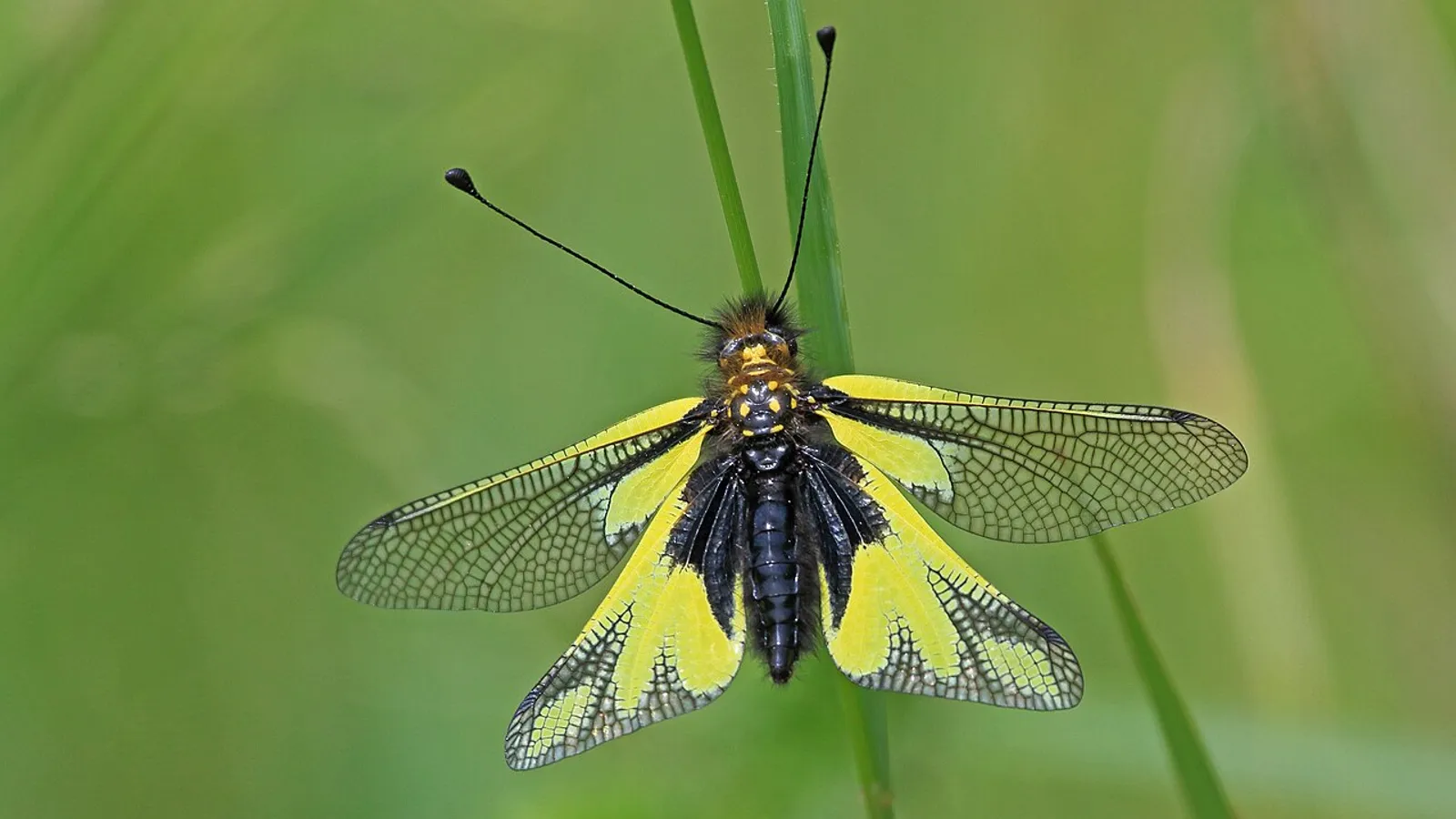
— Where the name comes from
The Italian name comes from Ascalaphus, who in Greek myth was the keeper of the underworld: it was he who revealed that Persephone had eaten the pomegranate seeds, condemning her to return underground each year, and Demeter punished him by turning him into a bird of the night. Libelloides means instead “dragonfly-like”, which is the thing it seems and is not: the long antennae with a club at the tip give it away at once.
— Facts
- Group
- Insects · Insecta
- Order
- Lacewings and antlions
- Habitat
- Dry grassland, sunny slopes, garrigue
- Range
- Southern and central Europe, from Spain to the Balkans
- Size
- 45–55 mm wingspan
- Diet
- Small insects caught in flight
- Lifespan
- A few weeks as an adult; two years as a larva
— Characteristics
- 01
It has long clubbed antennae, which no dragonfly possesses.
- 02
It flies only in the hottest hours and perches head down on stems.
- 03
The larva resembles an antlion’s but digs no traps.
— What sets it apart
It is an entirely solar animal: it flies only in full sun above twenty degrees, and the moment a cloud passes it grips a stem, folds its wings into a roof and stays motionless until the light returns. Its body is covered with dense fur that is both insulation and a collector of heat. The larva lives two years among stones and lichens, camouflaged under debris it glues to itself, and hunts with the same pincer jaws as the antlion — only instead of waiting at the bottom of a funnel it sits still in the open, indistinguishable from gravel.
