
Nine-banded armadillo
Dasypus novemcinctus
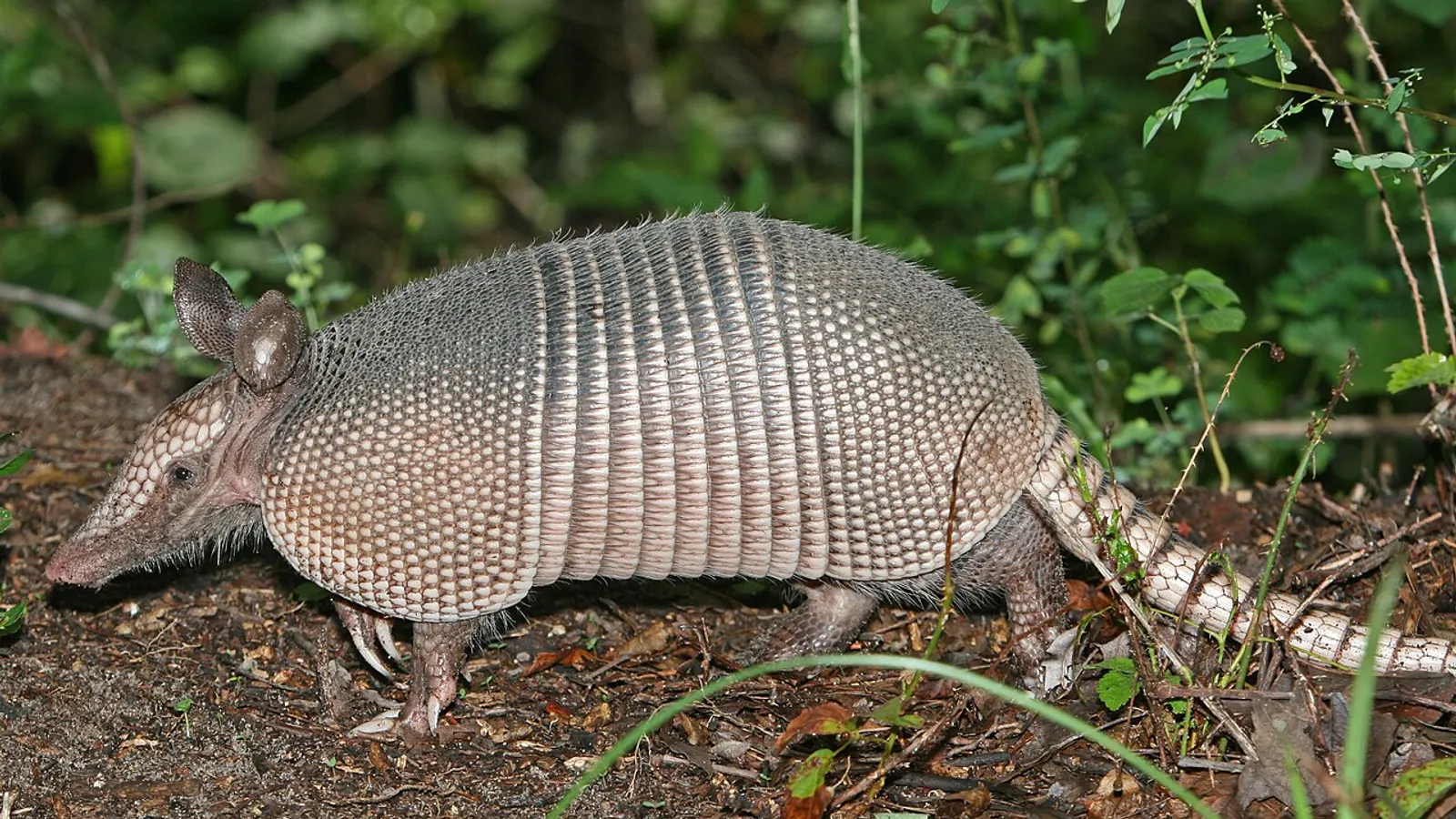
— Where the name comes from
Dasypus is the latinisation of the Greek dasýpous, “hairy foot”, a term the ancients used for the hare and which Linnaeus reused, improperly, for these armoured mammals. Novemcinctus is pure Latin, “nine-girdled”, from the movable bands that run across the armour between the front and rear shields. The common name comes instead from the Spanish armadillo, a diminutive of armado, “armed”: the little armoured one. Curiously the bands are not always nine: they range from seven to eleven from animal to animal.
— Facts
- Group
- Mammals · Mammalia
- Order
- Armadillos
- Habitat
- Damp woodland, scrub and grassland with soft soil
- Range
- From the south-central United States to northern Argentina and Uruguay
- Size
- 38–58 cm of body plus 26–45 cm of tail, 2.5–6.5 kg
- Diet
- Insectivore — beetles, ants, termites, earthworms and occasionally fungi and eggs
- Lifespan
- 7–10 years in the wild, up to 20 in captivity
— Characteristics
- 01
It can hold its breath for up to six minutes and cross watercourses by walking along the bottom.
- 02
Alternatively it inflates stomach and intestine with air to float and swim at the surface.
- 03
It has very weak eyesight and finds its way almost entirely by smell, detecting prey up to 20 cm down.
— What sets it apart
Every litter of the nine-banded armadillo produces, almost without exception, four genetically identical young, born from the division of a single fertilised embryo: it is the only mammal known in which obligate polyembryony is the rule. That has made it a valuable laboratory model, because it supplies quartets of natural twins on which the effect of environment can be separated from that of genes. The species is also one of the very few animals besides ourselves to contract leprosy, and for decades it allowed the bacillus, otherwise impossible to culture, to be grown. An ancient and unassuming animal has ended up at the centre of modern medical research.
