
European spiny lobster
Palinurus elephas
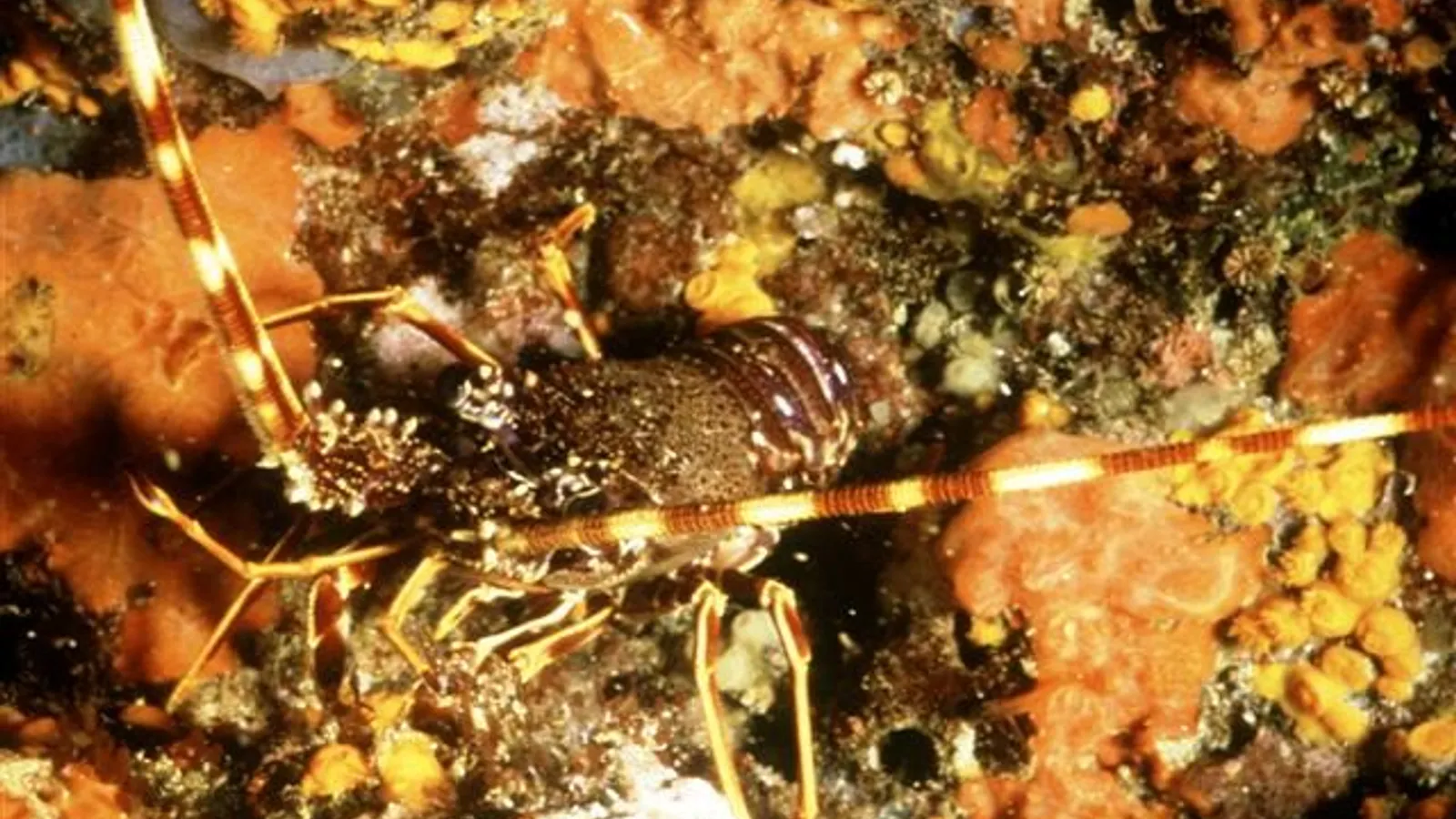
— Where the name comes from
Palinurus is the helmsman of Aeneas: in the Aeneid he falls asleep at the tiller, drops into the sea and drowns off the headland that still bears his name, Capo Palinuro. Elephas is the elephant, for the long stout antennae the animal waves before it like trunks. The name puts together a shipwreck and a pachyderm, and says nothing of what the lobster actually does — which is to walk in single file across the sea floor.
— Facts
- Group
- Crustaceans · Malacostraca · Maxillopoda
- Order
- Crabs, lobsters and shrimps
- Habitat
- Rocky and coralligenous bottoms between 20 and 150 metres
- Range
- Mediterranean and eastern Atlantic, from Norway to Morocco
- Size
- 20–50 cm, up to 8 kg
- Diet
- Molluscs, urchins, worms, carrion
- Lifespan
- 15–20 years
— Characteristics
- 01
It has no claws: it defends itself with spiny antennae and backward flight.
- 02
It rasps by rubbing the base of the antenna against the carapace.
- 03
The larva is flat and transparent and drifts for months in the plankton.
— What sets it apart
It makes a sound that does not depend on its shell. Almost all crustaceans that rasp do so by rubbing two hard parts together, and after moulting — when the shell is soft — they fall silent exactly when they are most vulnerable. The spiny lobster solved the problem with a viscous-friction mechanism: a small plate slides over a smooth surface like a wetted bow on a string, and it works even with a soft shell. The sound carries tens of metres underwater. The larva is unrecognisable: flat as a microscope slide, transparent, with very long legs, it drifts for as much as ten months before settling and becoming a lobster.
