
Natterer's bat
Myotis nattereri
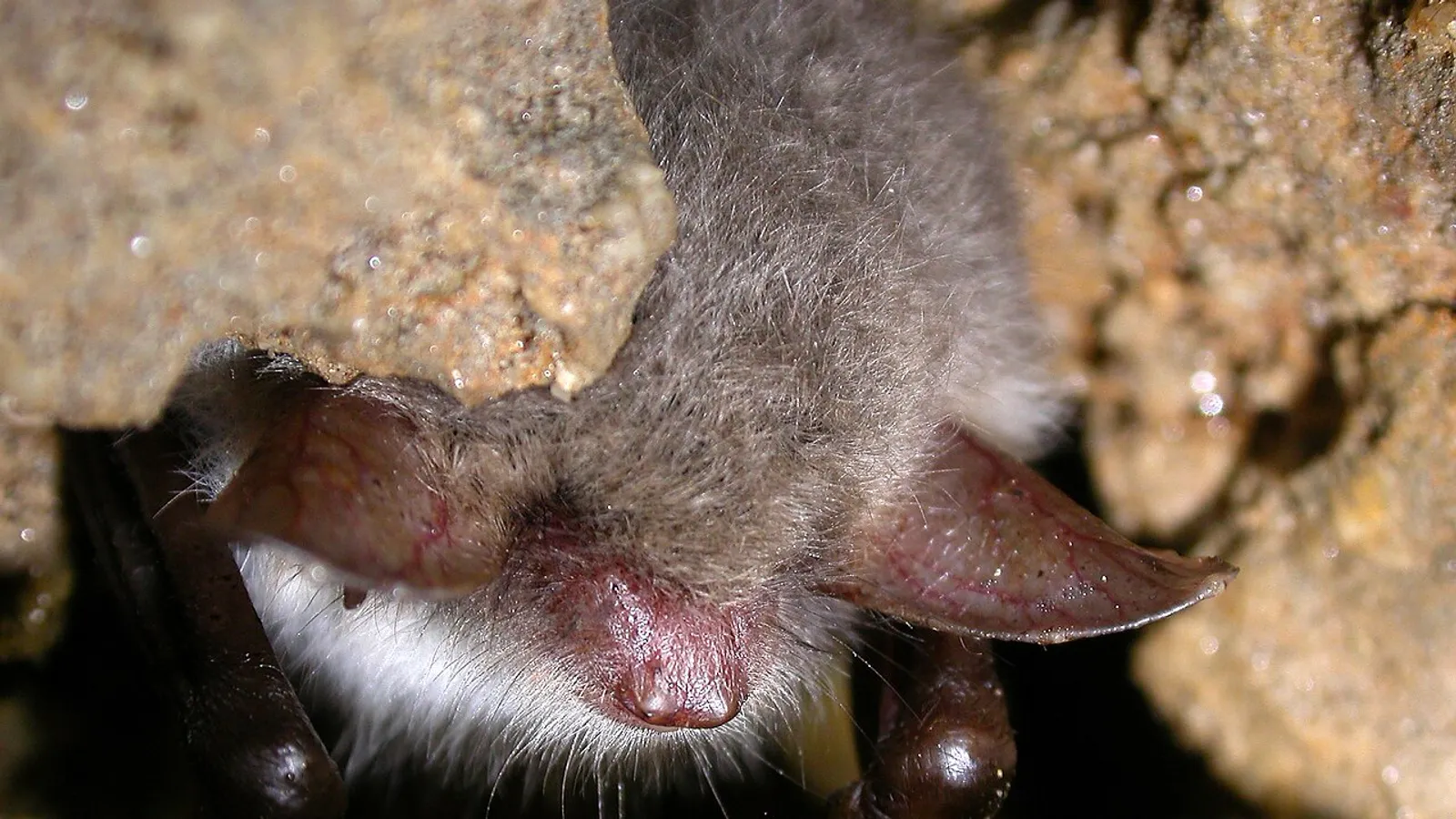
— Where the name comes from
Nattereri recalls Johann Natterer, the Austrian naturalist who spent eighteen years in Brazil — from 1817 to 1835 — gathering for the Vienna museum one of the largest South American collections of the 19th century, and who lost most of his notes in a fire. The name of the European species that bears his surname was given by a colleague, on Austrian material.
— Facts
- Group
- Mammals · Mammalia
- Order
- Bats
- Habitat
- Woodland, parks, bridges and attics; hunting along dense vegetation
- Range
- Europe, North Africa, western Asia as far as the Urals
- Size
- 4–5 cm of body, 27 cm wingspan, 5–12 g
- Diet
- Insectivore — insects and spiders gathered off leaves, branches and the ground
- Lifespan
- Up to 20 years
— Characteristics
- 01
The edge of the tail membrane carries a fringe of stiff curved bristles.
- 02
It uses the tail membrane as a spoon to scoop up prey.
- 03
Its flight is very slow and highly manoeuvred, almost helicopter-like.
— What sets it apart
It hunts with a scoop. The margin of the membrane between the hind legs carries a double row of stiff, incurved bristles, and the animal uses that surface as a spoon: it drops onto an insect sitting on a leaf, gathers it with the membrane folded forward and brings it to its mouth without ever stopping. The fringe stops the prey sliding out — a detail no other European Myotis has, and one visible only with the animal in the hand.
