
Nile monitor
Varanus niloticus
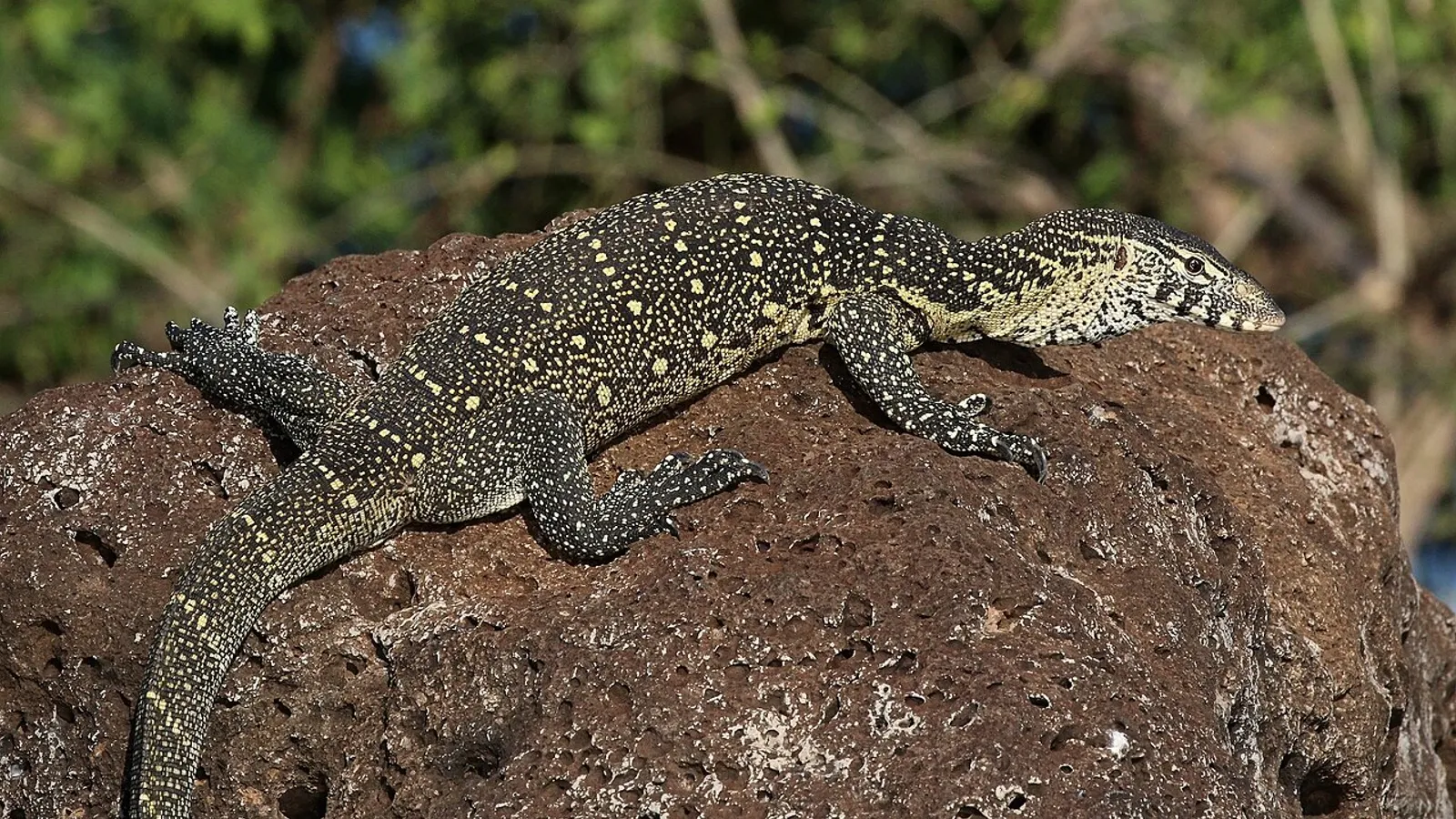
— Where the name comes from
Varanus comes from the Arabic waral, the name of these reptiles across North Africa. When the word reached Europe somebody connected it to the German warnen, “to warn”, and the legend was born that the animal gave notice of crocodiles: hence the English monitor lizard. The name is thus the residue of a misunderstanding between two languages that are not related at all.
— Facts
- Group
- Reptiles · Reptilia
- Order
- Squamates
- Habitat
- River banks, lakes, marshes, savannah near water
- Range
- Sub-Saharan Africa and the Nile valley; introduced to Florida
- Size
- 1.2–2.2 m, 5–15 kg
- Diet
- Fish, crabs, eggs, birds, rodents, carrion
- Lifespan
- 15 years
— Characteristics
- 01
It swims extremely well and stays submerged for up to an hour.
- 02
It lays its eggs inside a termite mound, which protects and warms them.
- 03
The tail is flattened sideways and works as an oar.
— What sets it apart
It is Africa’s most efficient robber of crocodile nests, and it works in pairs: one lets itself be chased by the guarding mother while the other digs in and helps itself. The scene has been filmed repeatedly, and the two swap roles. In the twentieth century this species was carried by accident to Florida, where it now plunders the nests of alligators and native turtles doing exactly the same job, with nothing to stop it.
