
Sunbittern
Eurypyga helias
— Where the name comes from
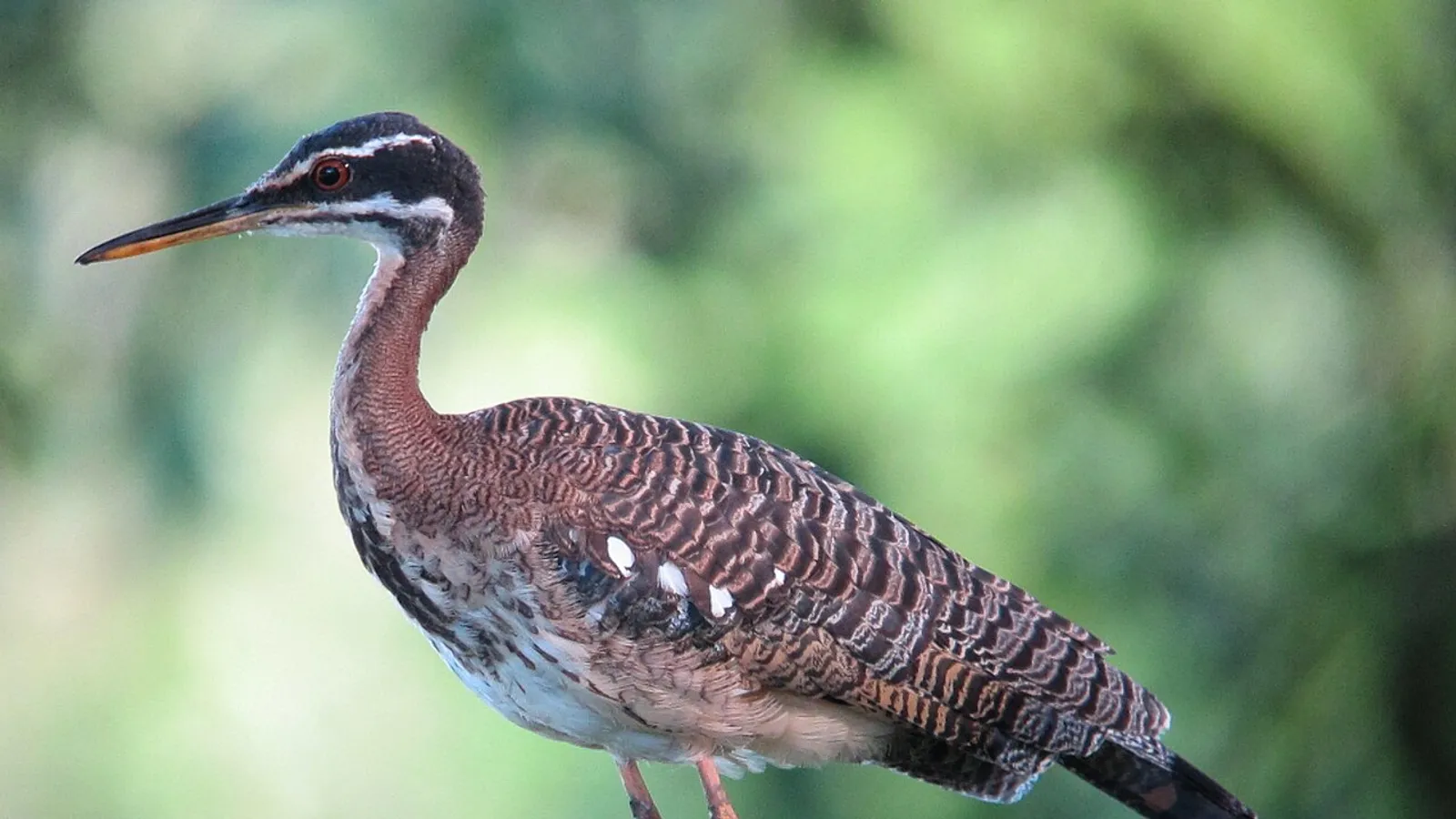
Eurypyga is “broad-rumped”, from eurýs and pygḗ; helias comes from Hḗlios, the sun. The name, in every language, comes from what happens when the animal opens its wings: two enormous red and black patches appear on the flight feathers, arranged like a sunset or like a pair of eyes, invisible while the wings stay shut.
— Facts
- Group
- Birds · Aves
- Order
- Sunbittern and kagu
- Habitat
- Streamsides in rainforest, up to 1,800 metres
- Range
- From Guatemala to Brazil and Peru
- Size
- 43–48 cm, 180–220 g
- Diet
- Insects, shrimp, tadpoles, small fish
- Lifespan
- 15 years in captivity
— Characteristics
- 01
It walks very slowly over wet stones, like a heron in miniature.
- 02
It snaps its wings open at a predator and appears to be an enormous animal.
- 03
It builds a nest of mud and leaves on a branch above the water.
— What sets it apart
Its nearest living relative is the kagu, a grey flightless bird that exists only in New Caledonia, seventeen thousand kilometres away. They are two lone species, each the only one in its order, separated by the Pacific and joined by the fact that both are leftover pieces of Gondwana: when their paths parted, South America and Australia were still attached. The rest of the group is gone, and these two remain, at opposite ends of the world.
