
Walrus
Odobenus rosmarus
— Where the name comes from
Odobenus is Greek for “the one who walks on his teeth”, from odoús, tooth, and baínō, I walk: it hauls itself onto the ice by planting its tusks. Rosmarus comes from Scandinavian, perhaps “sea horse”. The Italian tricheco goes back to the Greek trícheks, by way of a name Pliny gave to a fish and later transferred to this Arctic giant.
— Facts
- Group
- Mammals · Mammalia
- Order
- Carnivores
- Habitat
- Arctic pack ice and coasts, over shallow water
- Range
- The Arctic Ocean and the seas around it
- Size
- 250–360 cm, 800–1,700 kg
- Diet
- Carnivore — bivalve molluscs sucked off the seabed
- Lifespan
- 30–40 years
— Characteristics
- 01
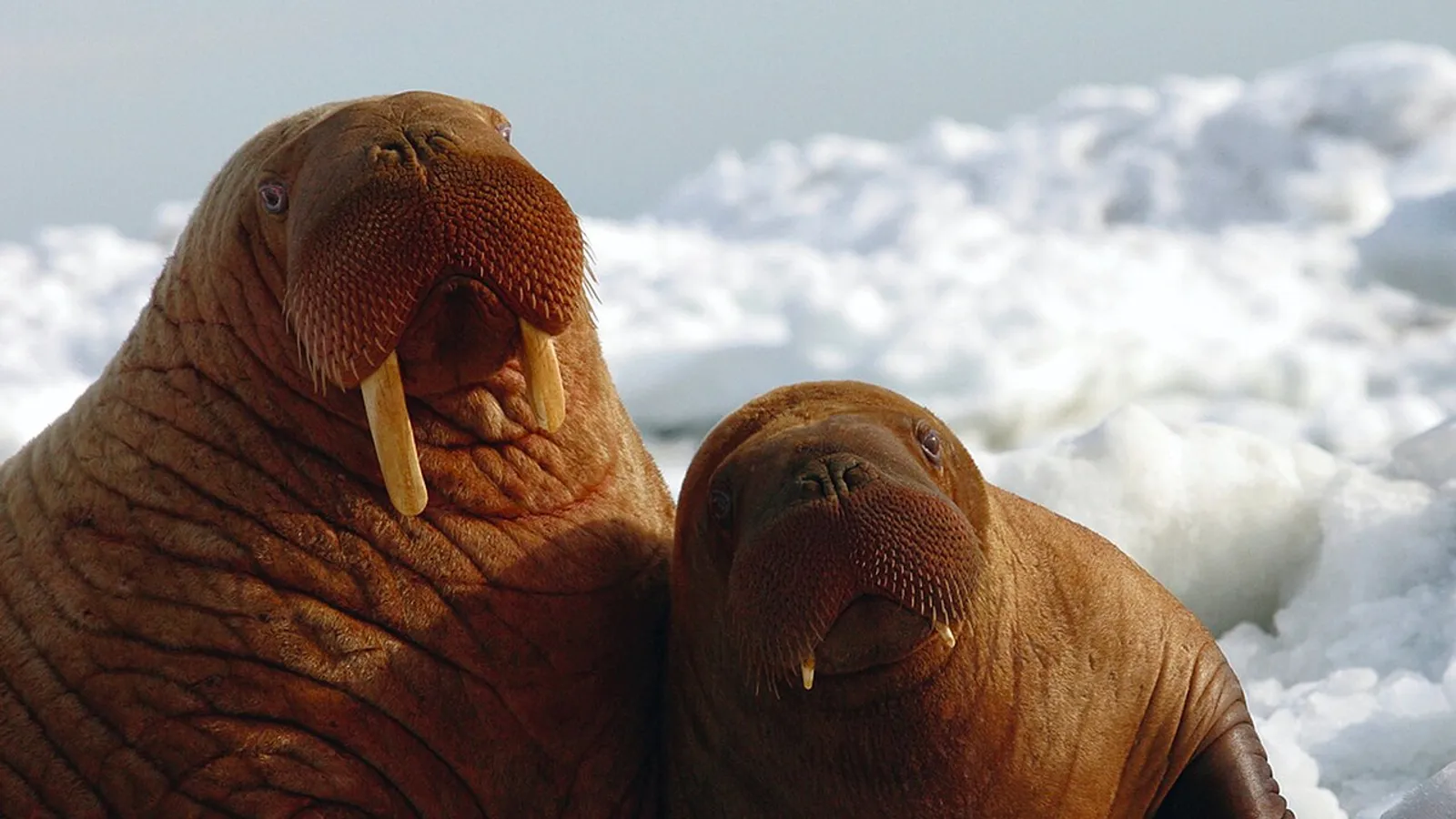
The tusks are elongated canines that grow all life long, in both sexes, up to a metre.
- 02
The stiff whiskers, the vibrissae, feel over the muddy bottom to find clams in the dark.
- 03
It gathers in thousands on ice floes and beaches, body against body.
— What sets it apart
The walrus does not bite clams open: it sucks them out. It presses its fleshy lips against the shell and creates a vacuum strong enough to pull the mollusc free in a fraction of a second. A single animal can empty thousands of bivalves in one meal, ploughing the Arctic seabed like a living harrow. The tusks, which look made for getting food, are in fact mostly for hauling out onto ice and for duelling.
