Takahē
Porphyrio hochstetteri
— Where the name comes from
Porphyrio was the Latin name of the purple swamphen, from the Greek porphyríōn, “the purple bird”. Hochstetteri honours Ferdinand von Hochstetter, the German geologist who explored New Zealand in the nineteenth century. Takahē is the Māori name, and it is known by that everywhere.
— Facts
- Group
- Birds · Aves
- Order
- Cranes and allies
- Habitat
- Alpine tussock grassland and mountain forest; predator-free islands
- Range
- New Zealand: the Murchison Mountains in Fiordland, protected islands and some valleys of the South Island
- Size
- 63 cm, 2–3 kg
- Diet
- The soft bases of tussock grasses, leaves, seeds, rhizomes
- Lifespan
- Up to 20 years
— Characteristics
- 01
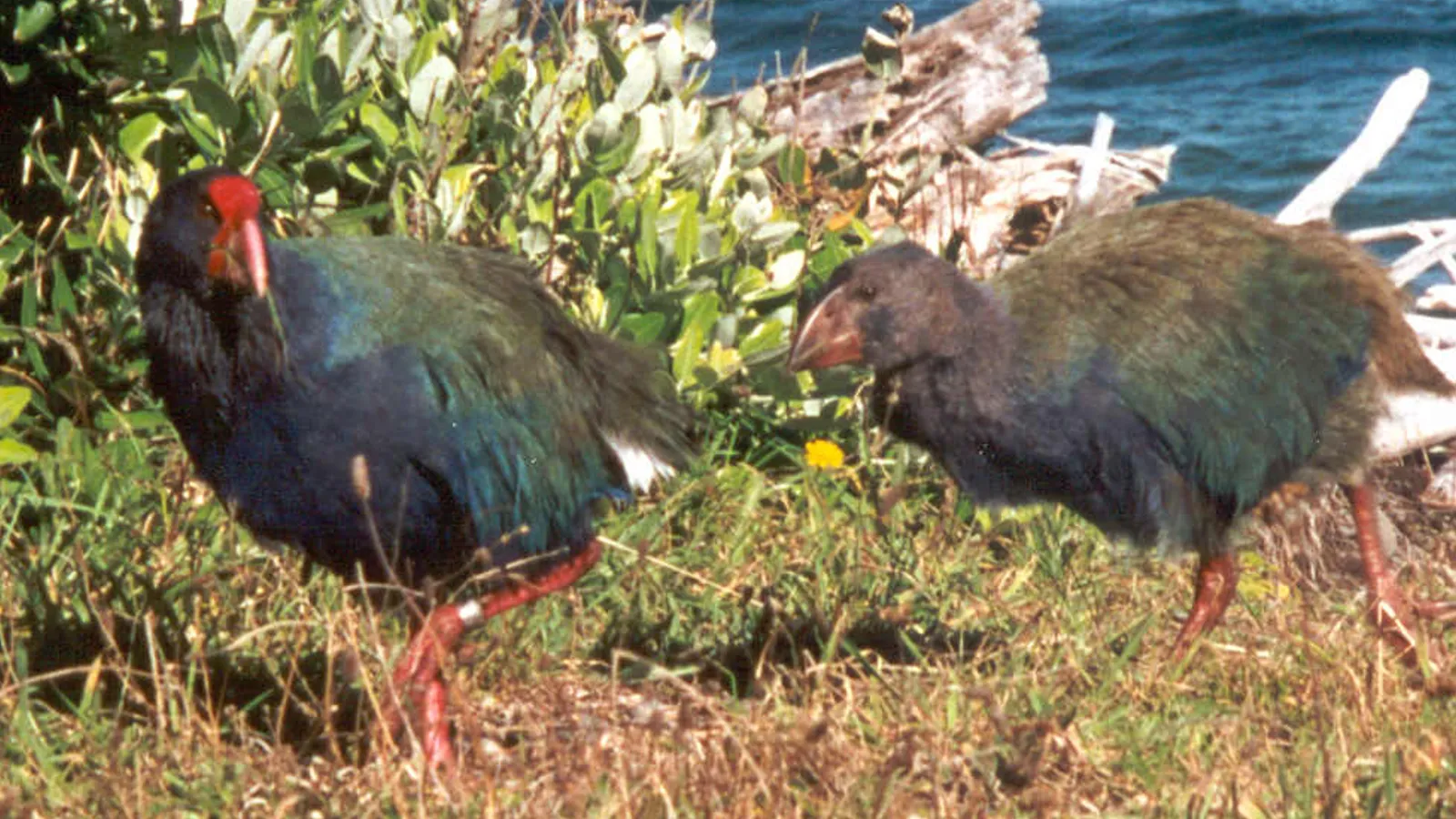
It is the largest living rail, and it cannot fly.
- 02
Its plumage is blue and green and it has a large red bill.
- 03
It eats only the tenderest part of the stems, leaving heaps of discarded leaves on the ground.
— What sets it apart
It was given up for extinct for fifty years. Four specimens caught in the nineteenth century were known, the last in 1898, and then nothing more. In 1948 a doctor with a passion for nature, Geoffrey Orbell, decided to look for it in a remote valley of the Murchison Mountains, following old accounts, and found it. The rediscovered population numbered a few hundred birds, and since then it has been defended inch by inch against stoats, deer and introduced cats: today takahē number a few hundred, enough to begin releasing them again into the valleys from which they had vanished.