
Whale shark
Rhincodon typus
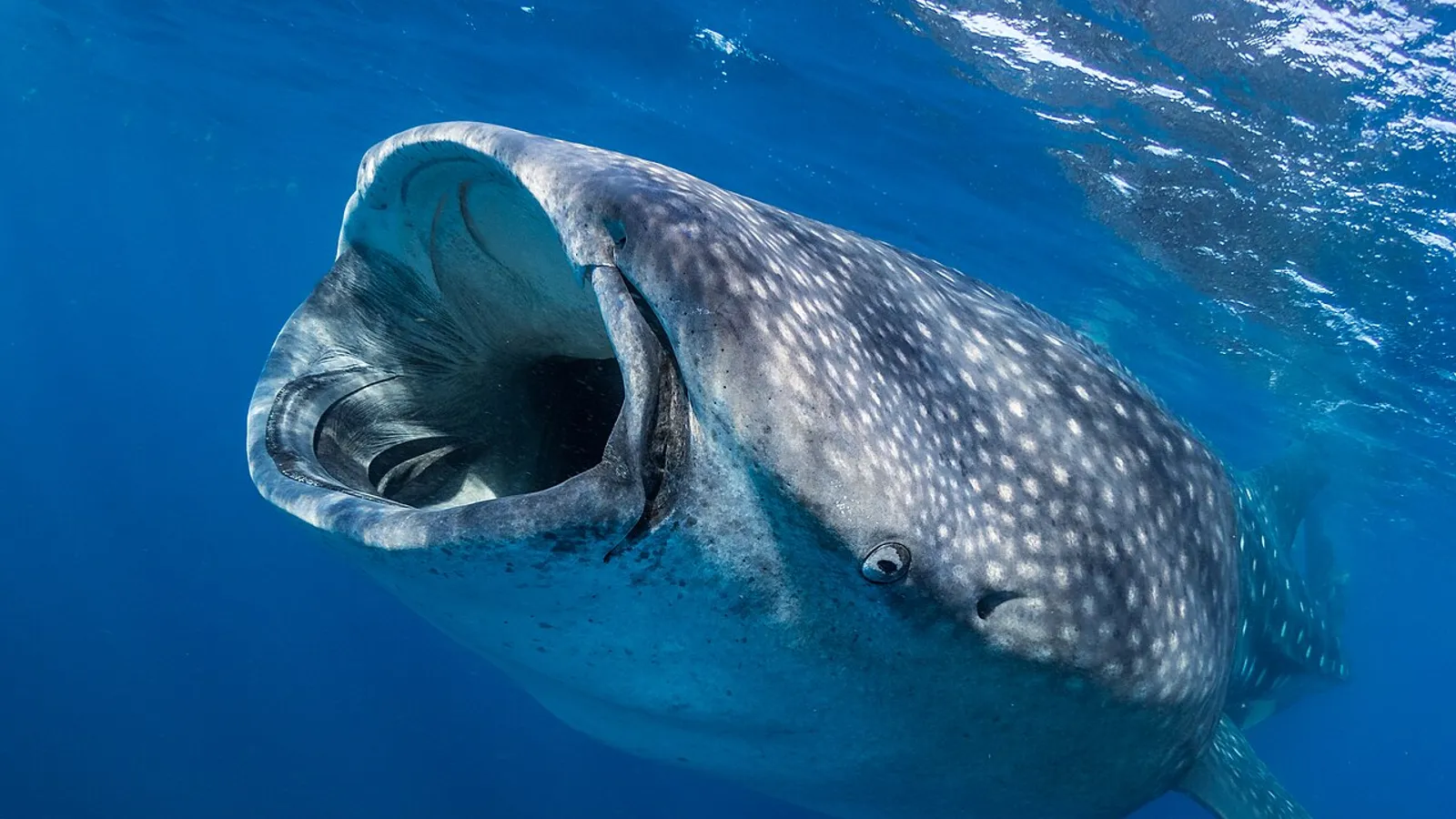
— Where the name comes from
Rhincodon is Greek for “tooth on the snout”, from rhýnchos, snout, and odoús, tooth; typus, “type specimen”. The common name joins its two natures: a shark as big as a whale, and as mild as one. It is the largest living fish, and yet it feeds on the ocean’s smallest prey.
— Facts
- Group
- Fish · Actinopterygii · Chondrichthyes
- Order
- Carpet sharks
- Habitat
- Open sea and tropical coasts, often at the surface
- Range
- All the warm seas of the world
- Size
- 10–12 m, up to 18 m, over 20,000 kg
- Diet
- Filter feeder — plankton, fish eggs, small fish
- Lifespan
- 70–100 years and more
— Characteristics
- 01
It is the largest fish on the planet, yet it filters plankton through gill pads.
- 02
Every individual has a unique pattern of white spots, like a fingerprint.
- 03
The skin on its back is up to 15 cm thick, the thickest of any animal.
— What sets it apart
The largest fish in the world eats the smallest creatures: it swims with its mouth agape, filtering tonnes of water to keep back plankton and eggs, entirely harmless to people. The pattern of white spots on its back is so distinctive that researchers identify individuals with software written to recognise constellations: the same algorithm used to map the stars serves to tell one animal from another. Every whale shark carries its own starry sky on its back.
