
Siamang
Symphalangus syndactylus
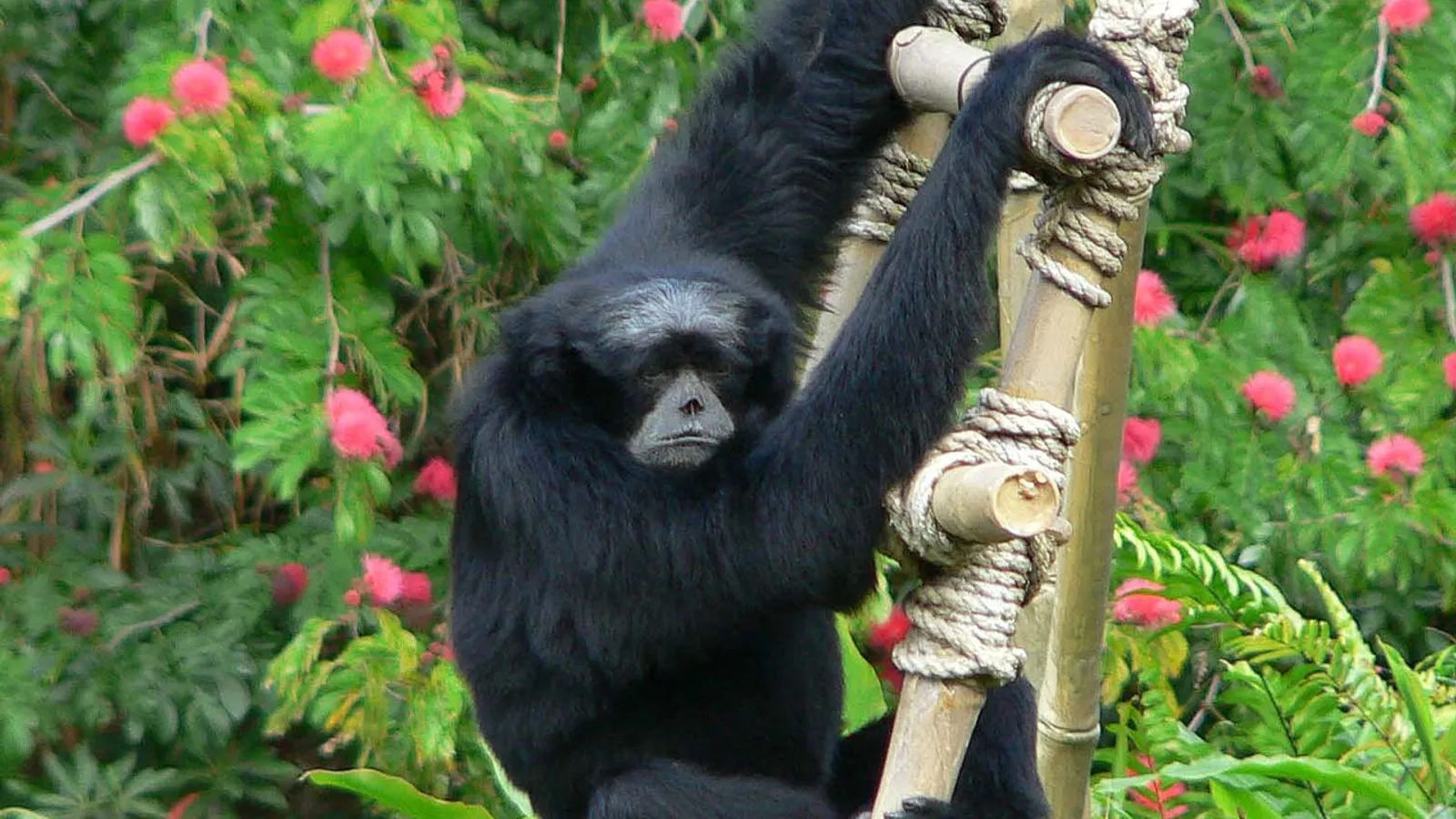
— Where the name comes from
Genus and species say the same thing twice in Greek: Symphalangus from sýn and phálanx, syndactylus from sýn and dáktylos — “joined phalanges”, “joined fingers”. The second and third toes of the foot are fused by a web of skin as far as the last joint, and it is the feature that separates it from all other gibbons. Siamang is the Malay name.
— Facts
- Group
- Mammals · Mammalia
- Order
- Primates
- Habitat
- Hill and montane rainforest, up to 1,500 m
- Range
- Sumatra and the Malay peninsula
- Size
- 75–90 cm, 10–14 kg
- Diet
- Frugivore — fruit and leaves in nearly equal parts
- Lifespan
- 25–30 years in the wild, over 40 in captivity
— Characteristics
- 01
It is the largest of the gibbons, twice the size of all the others.
- 02
It has a bare throat sac which it inflates to the size of its head.
- 03
Pairs are monogamous and sing coordinated duets audible two kilometres away.
— What sets it apart
The pair’s duet is not a chorus: it is a two-part score with different, assigned roles. Male and female each have their own phrases, which interlock in a fixed sequence and are performed in order, the female launching the great rising whoop and the male answering. Pairs that have been together longer perform the duet with fewer overlapping errors, and researchers use precisely that as a measure of the bond’s strength — the coordination improves with the years, as in an ensemble.
