
Indian giant squirrel
Ratufa indica
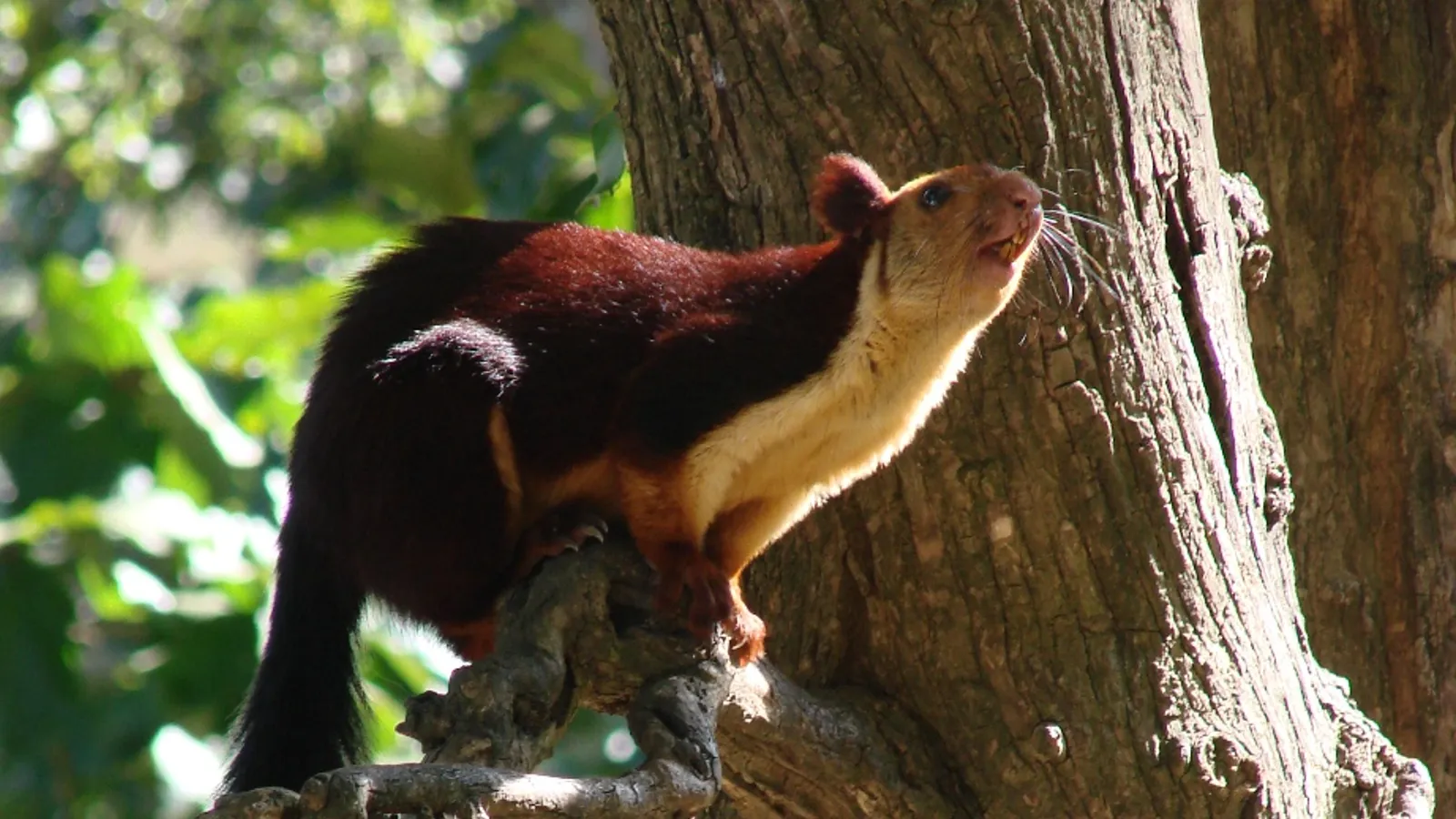
— Where the name comes from
Ratufa is the latinisation of an Indian name for the animal, gathered by colonial naturalists and kept untranslated. Indica, “of India”, is all the binomial says — a name that describes nothing and jars with the most conspicuous animal in the Indian forest, its coat blotched brown, orange and purple.
— Facts
- Group
- Mammals · Mammalia
- Order
- Rodents
- Habitat
- Moist and deciduous forest, always in the high canopy
- Range
- Peninsular India, above all the Western Ghats
- Size
- 25–50 cm of body, tail up to 60 cm, 1.5–2 kg
- Diet
- Fruit, seeds, bark, eggs, insects
- Lifespan
- 20 years in captivity
— Characteristics
- 01
It leaps between branches covering six metres in a bound.
- 02
It builds globular nests of twigs, and keeps several within the same territory.
- 03
It comes down to the ground very little: it spends nearly its whole life above ten metres.
— What sets it apart
It is the state animal of Maharashtra, and that has had concrete consequences: the Bhimashankar sanctuary was established in 1985 precisely for it, and it is one of the rare cases in which an Indian reserve is founded around a rodent rather than a tiger or an elephant. Its presence is betrayed by the nests — the size of footballs, hung from thin branches no heavy predator can reach.
