
Abert's squirrel
Sciurus aberti
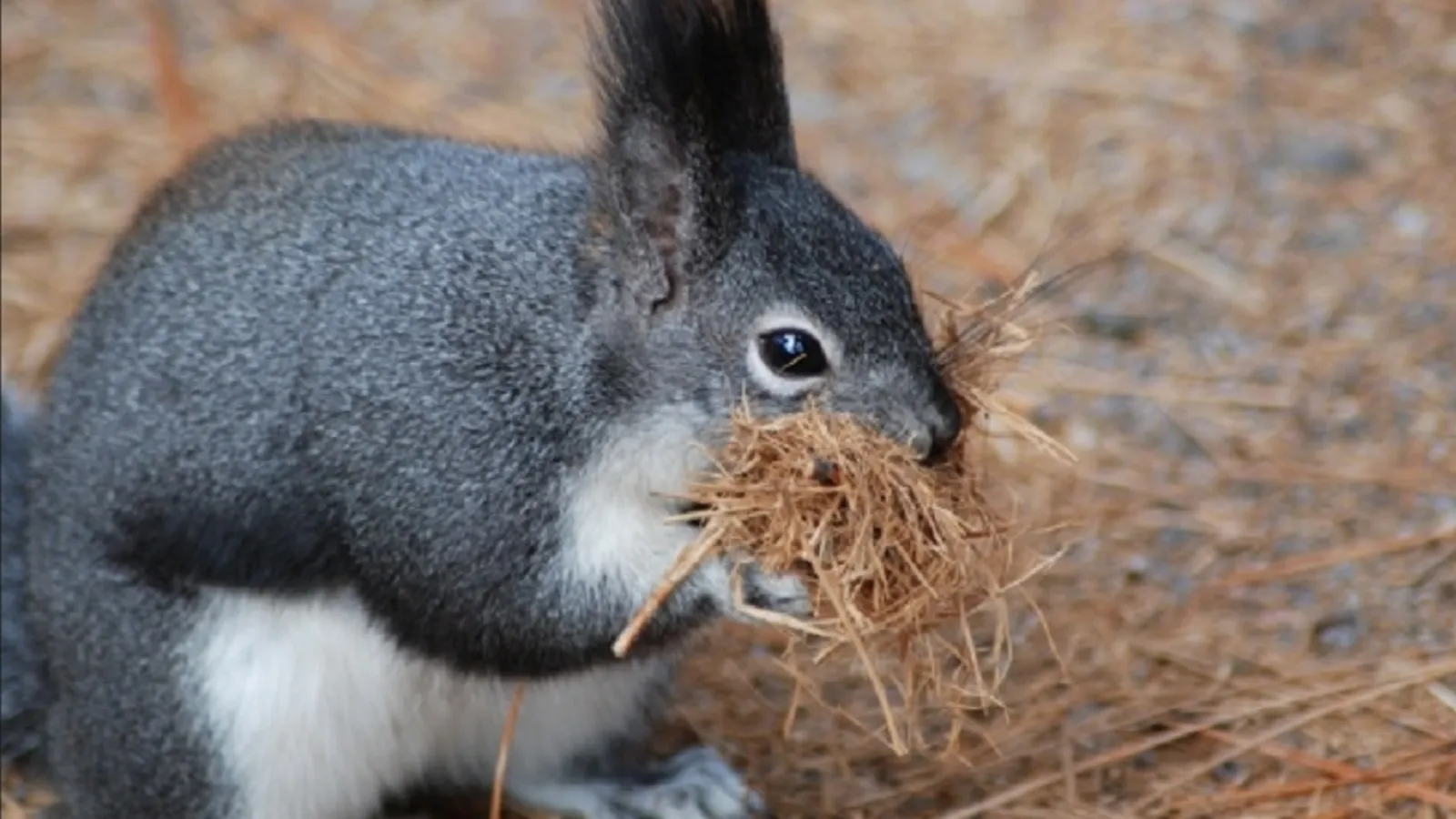
— Where the name comes from
It bears the name of Colonel John James Abert, who in the mid-19th century ran the topographical corps of the United States Army and organised the expeditions that mapped the American west. The squirrels were collected by naturalists attached to those caravans, and naming them after the man who signed the orders was the customary way of saying thank you.
— Facts
- Group
- Mammals · Mammalia
- Order
- Rodents
- Habitat
- Pure ponderosa pine forest, between 1,900 and 3,000 m
- Range
- The southern Rocky Mountains, Arizona, New Mexico, Colorado, Utah
- Size
- 46–58 cm including tail, 540–970 g
- Diet
- Inner bark, buds and seeds of ponderosa pine, underground fungi
- Lifespan
- 4 years in the wild
— Characteristics
- 01
The ear tufts, up to five centimetres long, grow in autumn.
- 02
It lays in no stores: all winter it eats the living bark of the branches.
- 03
It depends almost entirely on a single species of tree.
— What sets it apart
It is chained to the ponderosa pine in a way that makes it a textbook case of isolation. Where the ponderosa forest stops, the squirrel stops: the populations on the plateaus north and south of the Grand Canyon are separated by barely twenty kilometres of desert and have already taken different paths, so much so that the northern one, with an all-white tail, is described as a subspecies of its own. It is evolution observed on an island surrounded not by water but by air that is too dry.
