
Japanese giant salamander
Andrias japonicus
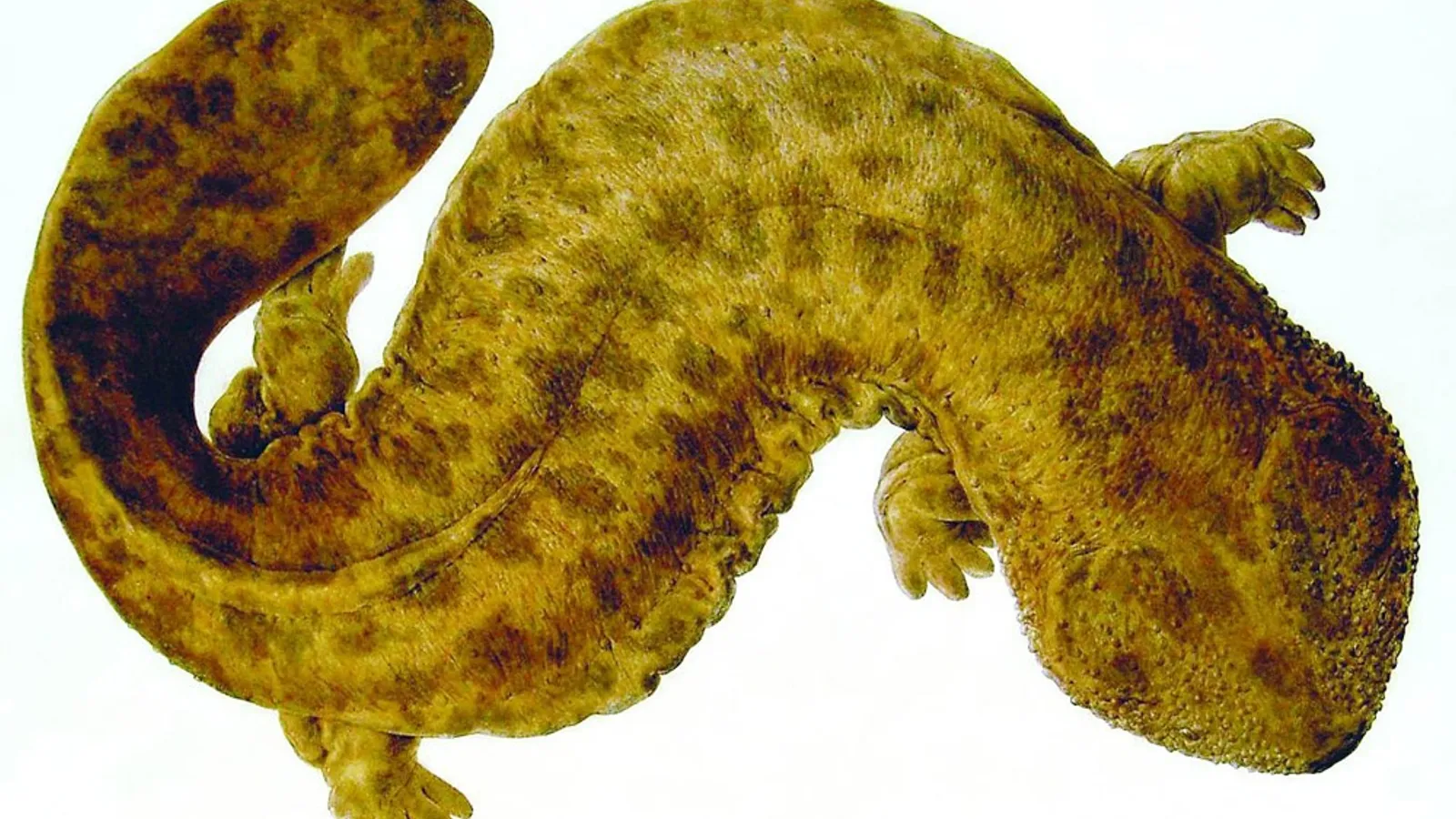
— Where the name comes from
Andrias is Greek for “image of a man”: an 18th-century fossil of the species was taken for the skeleton of a man drowned in the Flood, and named Homo diluvii testis, “man who witnessed the Deluge”. Japonicus places it in Japan. It is the second largest amphibian in the world.
— Facts
- Group
- Amphibians · Amphibia
- Order
- Salamanders
- Habitat
- Cold, clear, oxygen-rich mountain rivers
- Range
- South-western Japan
- Size
- Up to 1.5 m, 25 kg
- Diet
- Carnivore — fish, crustaceans, aquatic insects
- Lifespan
- Over 50 years, up to 80
— Characteristics
- 01
It breathes almost entirely through its wrinkled skin, which increases the exchange surface.
- 02
It sees very little: it hunts in the dark by sensing vibrations and smells in the water.
- 03
It is among the longest-lived amphibians: some individuals pass seventy.
— What sets it apart
A giant salamander fossil was, in 1726, the most celebrated proof of a scientific blunder: the naturalist Johann Scheuchzer described it as the skeleton of a sinner drowned in the universal Flood, calling it “the man who witnessed the Deluge”. Only a century later was it understood to be an amphibian. When the genus was established, scientists named it Andrias, “image of a man”, preserving that famous error in the name for ever.
