Alpine swift
Tachymarptis melba
— Where the name comes from
Tachymarptis joins the Greek tachýs, “swift”, and márptis, “seizer”: “the quick grabber”, for the insects it catches in flight with its mouth open. Melba is the epithet Linnaeus gave it when he still counted it among the swallows, Hirundo melba, and its meaning remains obscure. In English it is the alpine swift.
— Facts
- Group
- Birds · Aves
- Order
- Hummingbirds and swifts
- Habitat
- Mountain and coastal cliffs, bell towers and old buildings
- Range
- Southern Europe, North Africa, Asia to India, East Africa; winters in Africa
- Size
- 20–23 cm, wingspan 54–60 cm, 75–120 g
- Diet
- Insects and spiders carried on the air
- Lifespan
- Over 20 years the record
— Characteristics
- 01
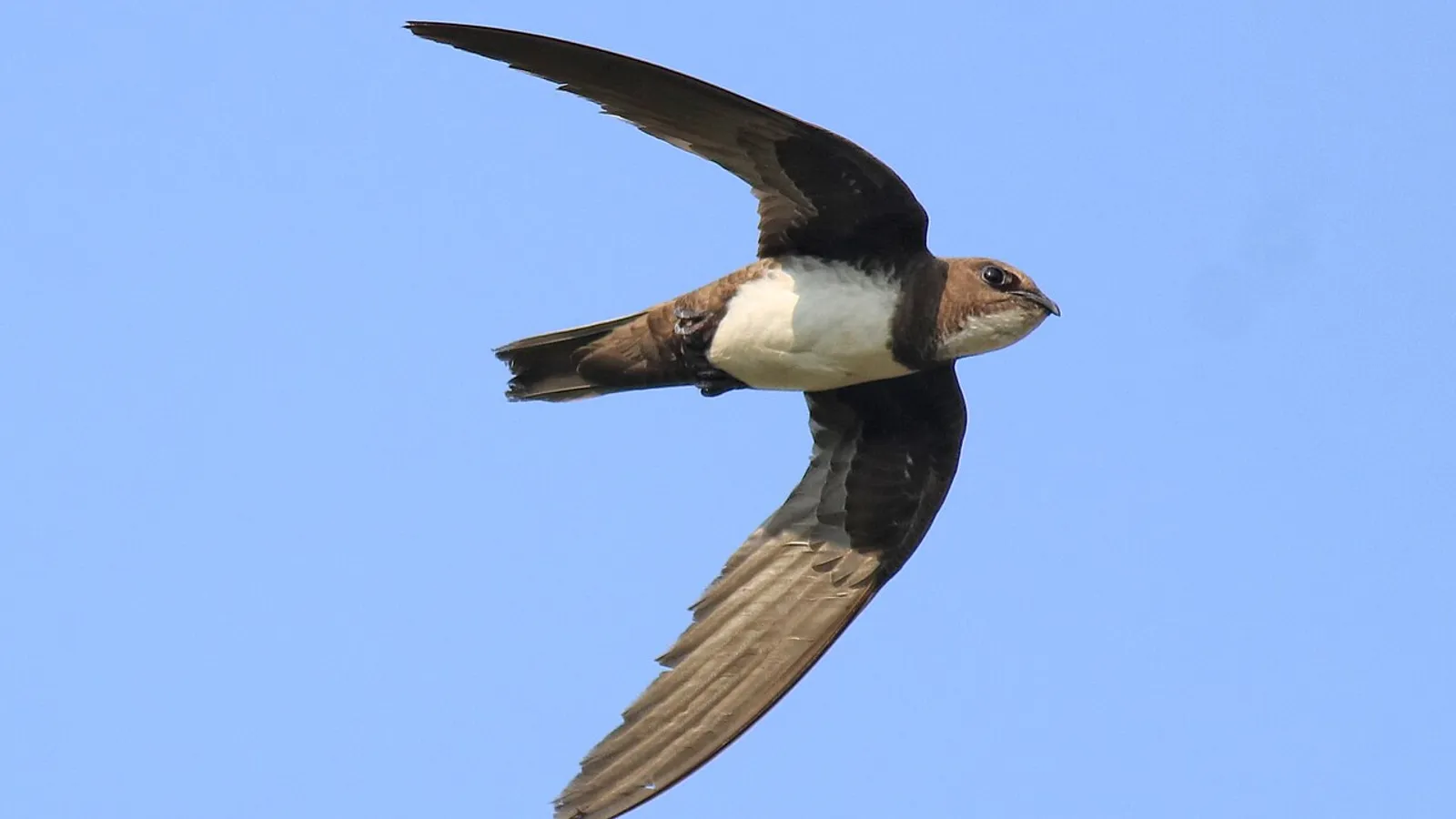
It has a white belly, which sets it apart from the all-dark common swift.
- 02
Its legs are so short that it struggles to take off from the ground.
- 03
It nests in colonies in crevices of rock and bell towers.
— What sets it apart
In 2013 some Swiss alpine swifts were fitted with tiny sensors that logged every movement, and when they were recaptured a year later the data were almost unbelievable: through migration and the African winter they had stayed airborne without ever landing for more than two hundred days in a row. They ate, drank and slept on the wing, at high altitude. It was the first direct proof that a bird can stay in the sky for over six months, and soon afterwards the same was found for the common swift.