
American bullfrog
Lithobates catesbeianus
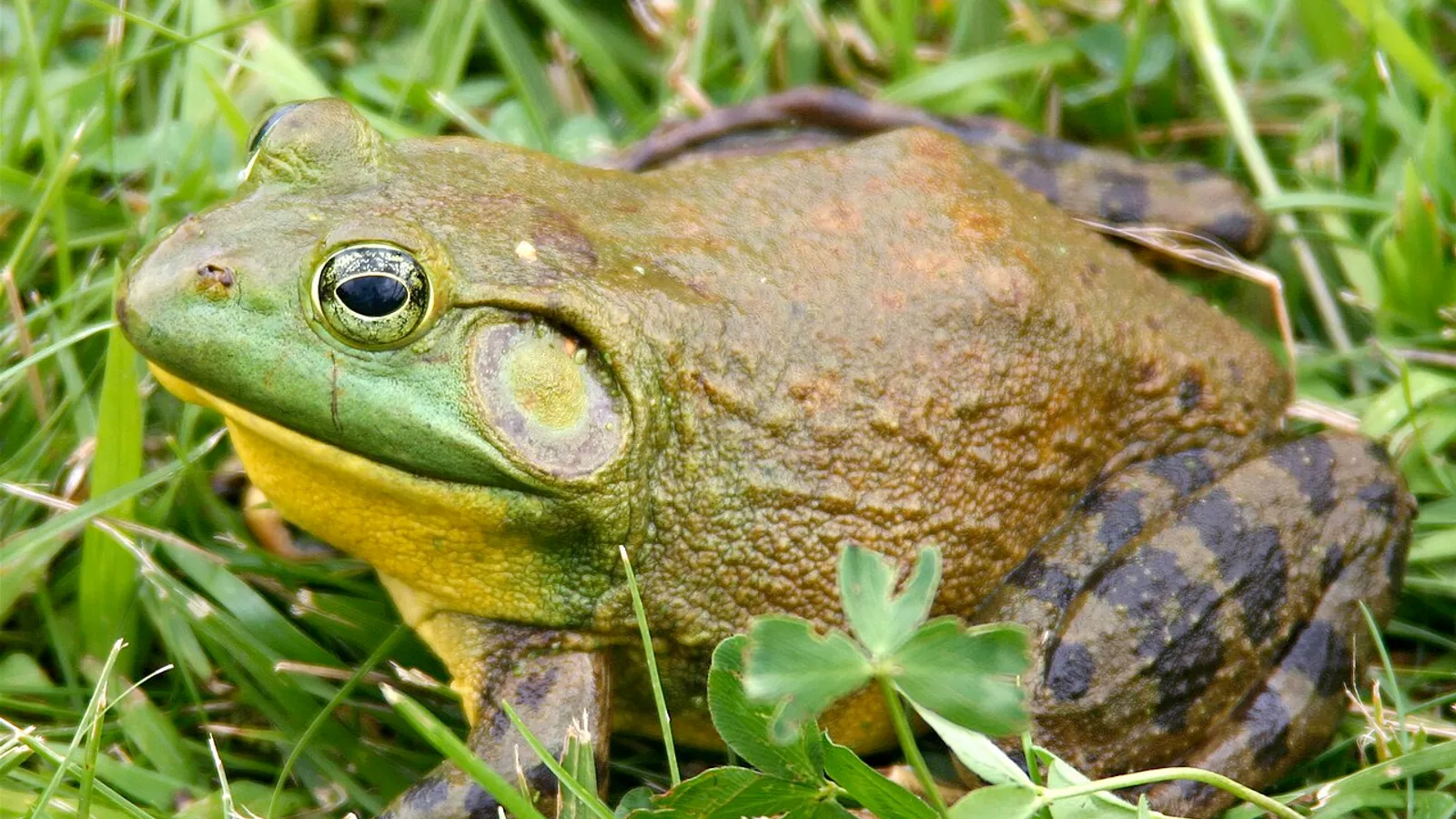
— Where the name comes from
Lithobates is “stone walker”, from líthos and bátēs. Catesbeianus recalls Mark Catesby, the English naturalist who in the eighteenth century drew the wildlife of Carolina in hand-coloured plates, the first European attempt to illustrate North America. The common name comes from the call: a deep boom like a distant bellow.
— Facts
- Group
- Amphibians · Amphibia
- Order
- Frogs and toads
- Habitat
- Ponds, lakes, canals, reservoirs with grassy margins
- Range
- Eastern North America; introduced to Europe, Asia and South America
- Size
- 9–15 cm, up to 20 cm; 300–800 g
- Diet
- Insects, fish, other frogs, snakes, small birds, mice
- Lifespan
- 8 years
— Characteristics
- 01
It eats anything that fits in its mouth, other amphibians included.
- 02
The tadpoles stay tadpoles for as much as two years before transforming.
- 03
The male holds a territory in the water and fights in it.
— What sets it apart
It has been carried across half the world for its legs, and it arrived with a fungus. Batrachochytrium dendrobatidis, which since the 1980s has crashed or extinguished hundreds of amphibian species on every continent, travels above all with animals moved by people, and this frog carries it without falling ill: it is the ideal healthy carrier. The largest wildlife epidemic ever documented spread, in large part, inside the crates of a food trade.
