
European garden spider
Araneus diadematus
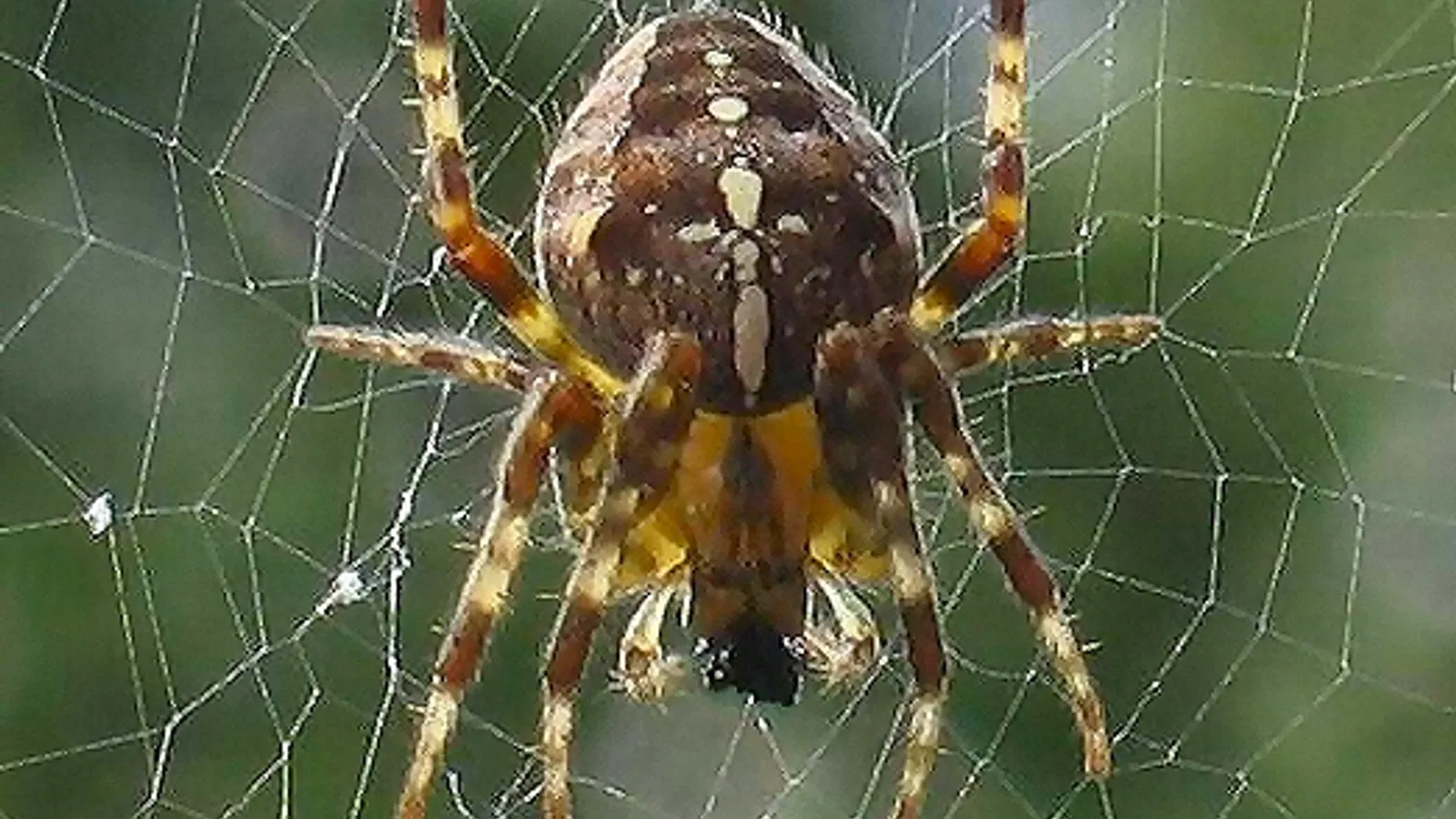
— Where the name comes from
Araneus is the Latin spider, and behind it stands Arachne: the Lydian weaver who challenged Athena to a contest of spinning and, having won, was turned by the goddess into an animal condemned to weave for ever. From her Greek name come “arachnid” and the whole class. Diadematus means “crowned”, for the white marks forming a cross on its back — the one detail the scientific name takes from the animal rather than the myth.
— Facts
- Group
- Arachnids · Arachnida
- Order
- Spiders
- Habitat
- Gardens, hedges, open woodland, anywhere to hang a web
- Range
- Europe and North America
- Size
- Female 10–18 mm, male 5–10 mm
- Diet
- Flying insects caught in the web
- Lifespan
- 1 year
— Characteristics
- 01
It rebuilds the web almost every night, eating the old one.
- 02
Only the spokes of the web are dry: the spiral is sticky.
- 03
It senses prey by vibration, holding a taut thread with one leg.
— What sets it apart
In 1948 the Swiss zoologist Peter Witt had the idea of giving these spiders psychoactive substances to see whether the web changed, and found that every substance produces a recognisable distortion: caffeine gives by far the most wrecked web, worse than LSD. In the 1990s NASA revived the experiment as a toxicity test. The web itself is an optimised structure: the radii are dry and are what the spider walks on, the spiral carries droplets of glue, and the spider dismantles and eats it each night to recover the protein — rebuilding costs it about an hour.
