
Raccoon
Procyon lotor
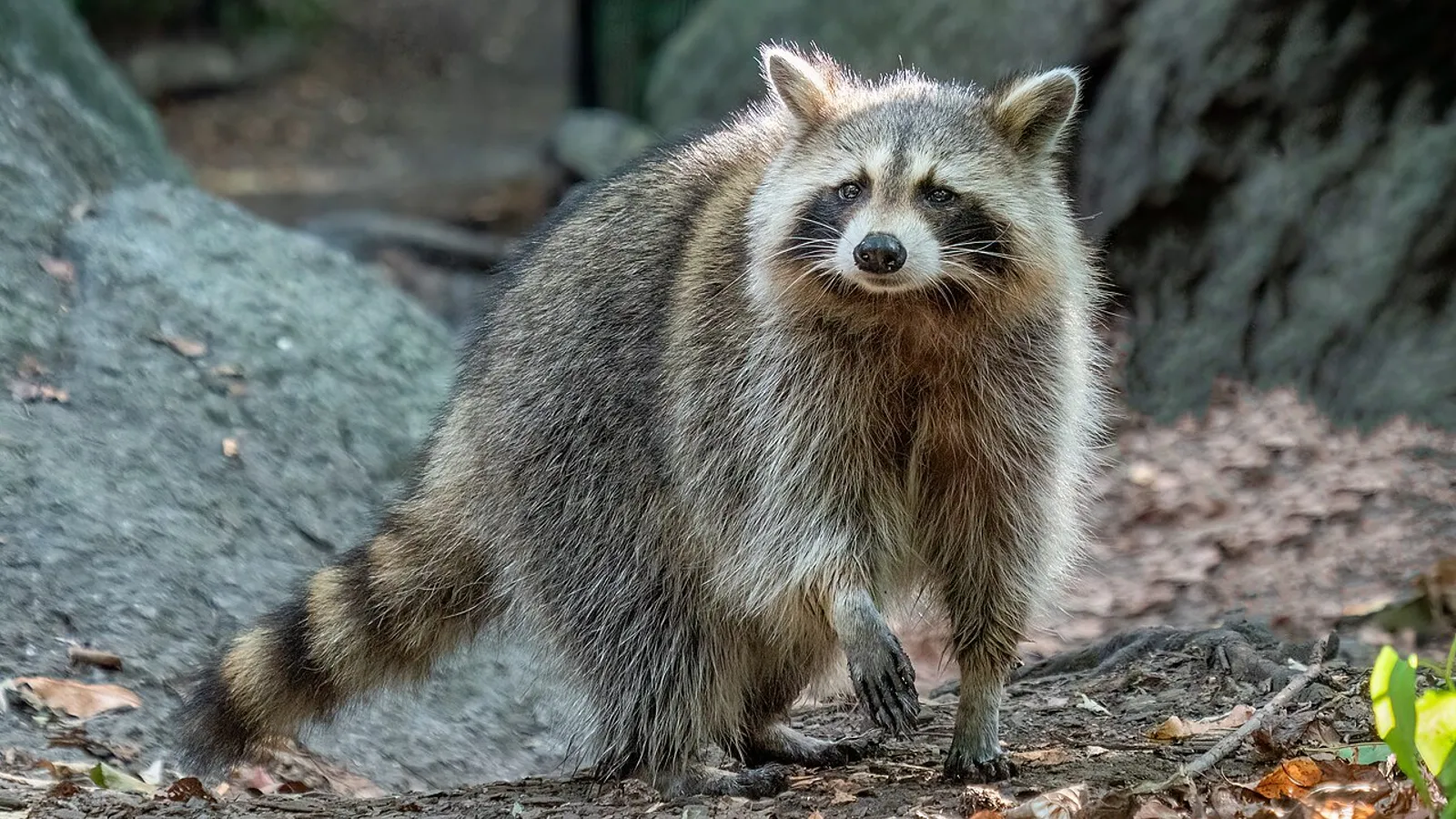
— Where the name comes from
Procyon joins the Greek pró, “before”, and kýon, “dog”: the same name as the star that rises just before Sirius, in Canis Minor. The genus was established in 1780 by Gottlieb Storr, with an uncertain reference either to the animal’s dog-like look or to the star of the same name. The epithet lotor, “washer”, is Linnaeus’s, who had noticed the habit of dipping food in water before eating. The Italian common name follows the genus, while the popular orsetto lavatore, “little washing bear”, translates the epithet faithfully.
— Facts
- Group
- Mammals · Mammalia
- Order
- Carnivores
- Habitat
- Deciduous and riparian woodland, often near water and cities
- Range
- North America, from southern Canada to Panama; introduced to central Europe, the Caucasus and Japan
- Size
- 40–70 cm of body plus 20–40 cm of tail, 4–12 kg
- Diet
- Omnivore — fruit, acorns, crayfish, amphibians, eggs and urban refuse
- Lifespan
- 2–3 years in the wild, up to 20 in captivity
— Characteristics
- 01
The tail carries five to eight dark rings and the face a black mask edged with pale fur.
- 02
The forepaws have five mobile digits and no opposable thumb, but enough to open catches, lids and handles.
- 03
Introduced to Europe in the 1930s, in some German cities it passes a hundred individuals per square kilometre.
- 04
In winter it enters torpor for weeks, without going into true hibernation.
— What sets it apart
The name lotor promises a washing that in the wild almost never happens: wild raccoons do not clean their food, they find it by feeling among the stones of riverbanks. The dunking seen in captive animals looks rather like a ritual of empty handling, inherited from that tactile search. Water, moreover, softens the horny layer of the palms and raises their sensitivity. In the raccoon’s cerebral cortex the portion given over to the forepaws is enormous, taking up a share of the sensory region no other carnivore matches. It is an animal that, quite literally, looks with its hands.
