
Mexican long-tongued bat
Choeronycteris mexicana
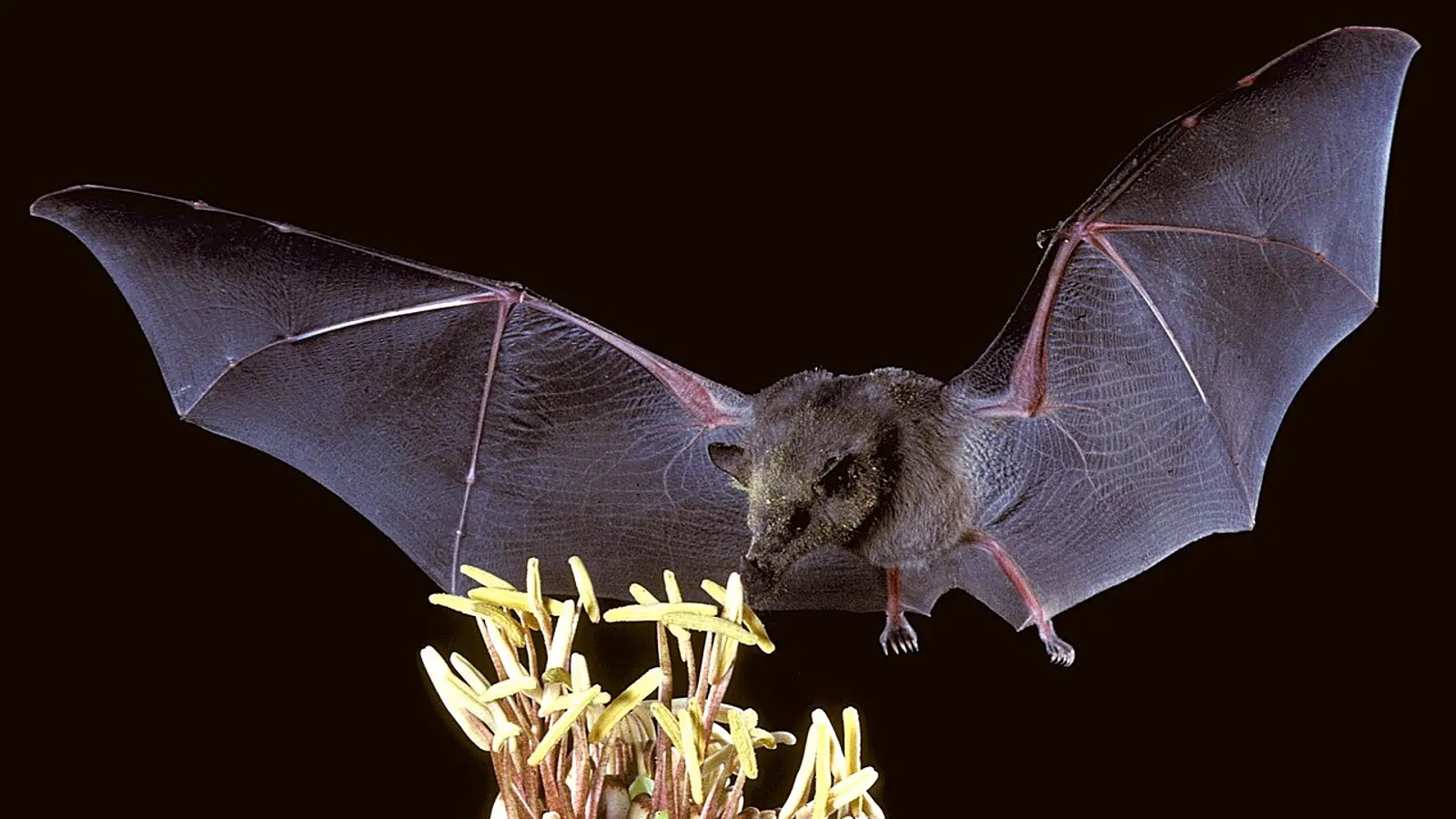
— Where the name comes from
Choeronycteris is “piglet bat”, from the Greek choîros, the suckling pig, and nykterís: the muzzle is long, cylindrical and ends in a small snout, which reminded its describer of a miniature swine. Mexicana names Mexico. It is the same principle as the “winged dog” of the Asian fruit bats — when the face does not look bat-like, one reaches for the nearest mammal.
— Facts
- Group
- Mammals · Mammalia
- Order
- Bats
- Habitat
- Caves, mines, garages and porches; foraging in desert and scrub
- Range
- From the south-western United States to Honduras
- Size
- 8–8.5 cm of body, 33 cm wingspan, 10–25 g
- Diet
- Nectar feeder — agave, columnar cacti, plus fruit and insects
- Lifespan
- Little known
— Characteristics
- 01
It has a tiny but present tail, unlike the other American nectar bats.
- 02
It often winters hanging in the porches and garages of Arizona houses.
- 03
It visits hummingbird feeders, emptying them overnight.
— What sets it apart
In Arizona and Texas some people discover its existence only because the hummingbird feeder is empty in the morning. The same sugar solutions that draw hummingbirds by day draw these bats by night, and they empty them within hours, hovering at the spout exactly as a bird would. Some associations have turned this into a survey programme: householders film their feeders at night, and from that footage migration routes are estimated.
