
Hoary bat
Lasiurus cinereus
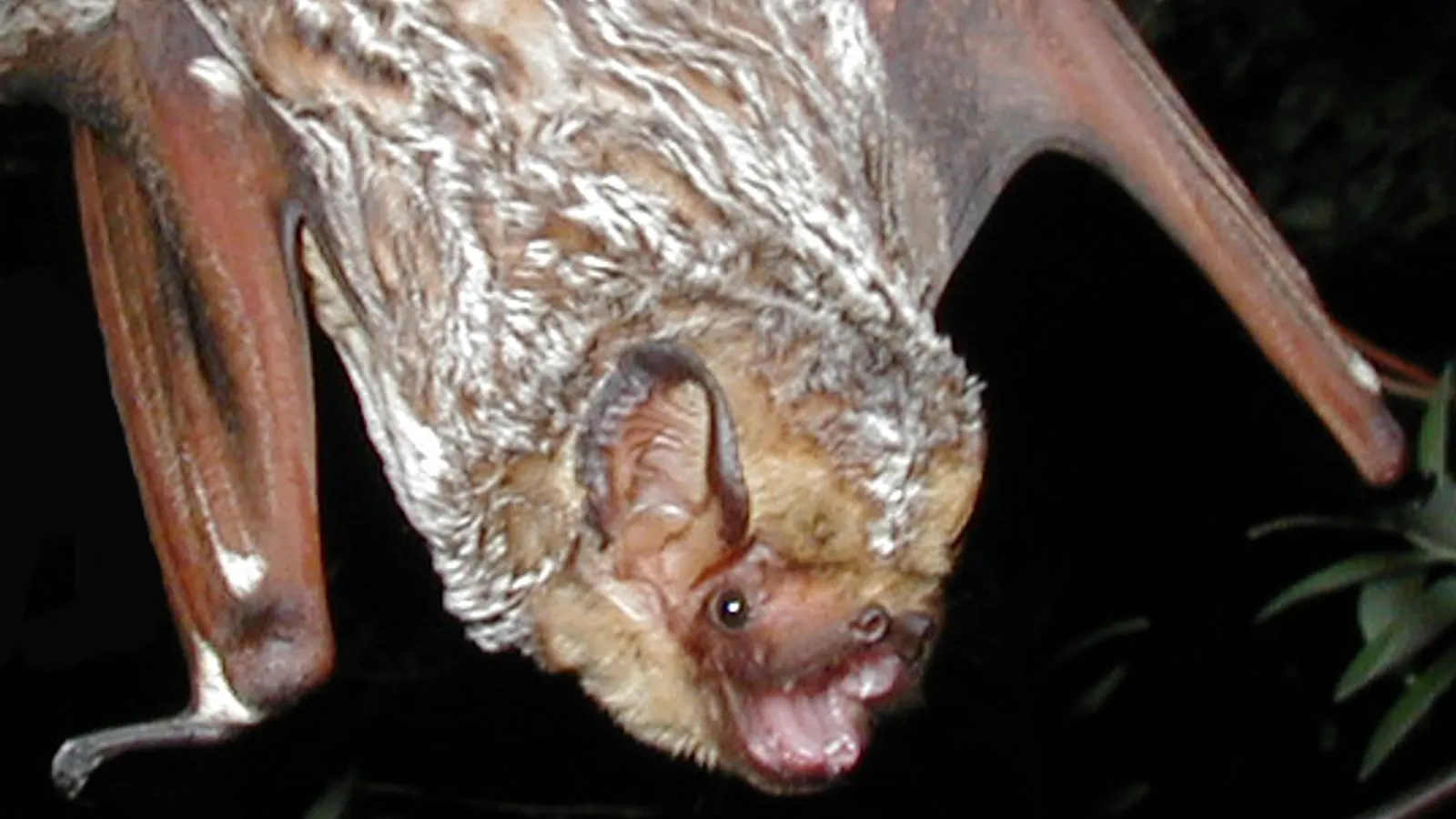
— Where the name comes from
Cinereus is the Latin “ash-coloured”, from cinis: every hair has a white tip on a brown ground, and the whole looks dusted with frost — in English it is indeed the hoary bat, from the word used for frost and for white hair. Lasiurus, “hairy tail”, states instead the adaptation that lets it sleep hanging from a branch in midwinter.
— Facts
- Group
- Mammals · Mammalia
- Order
- Bats
- Habitat
- Tree foliage, from boreal woodland to tropical forest
- Range
- From Canada to Argentina; a subspecies in Hawaii
- Size
- 13–15 cm including tail, 40 cm wingspan, 20–35 g
- Diet
- Insectivore — chiefly moths, taken in fast high flight
- Lifespan
- Little known
— Characteristics
- 01
It has the widest range of any bat in the Americas.
- 02
It reached Hawaii on its own, across 3,700 km of open ocean.
- 03
It is the species worst affected by wind turbines in North America.
— What sets it apart
It is the only native land mammal of Hawaii, and it got there by flying. Its ancestor crossed nearly four thousand kilometres of open Pacific — probably driven by a storm, perhaps in several waves — and colonised an archipelago no other mammal had ever reached. The Hawaiian population, ʻōpeʻapeʻa in the local language, is today a distinct and endangered subspecies, while the mainland one thrives everywhere: the same species, safe on a continent and fragile on an island.
