
Hairless bat
Cheiromeles torquatus
— Where the name comes from
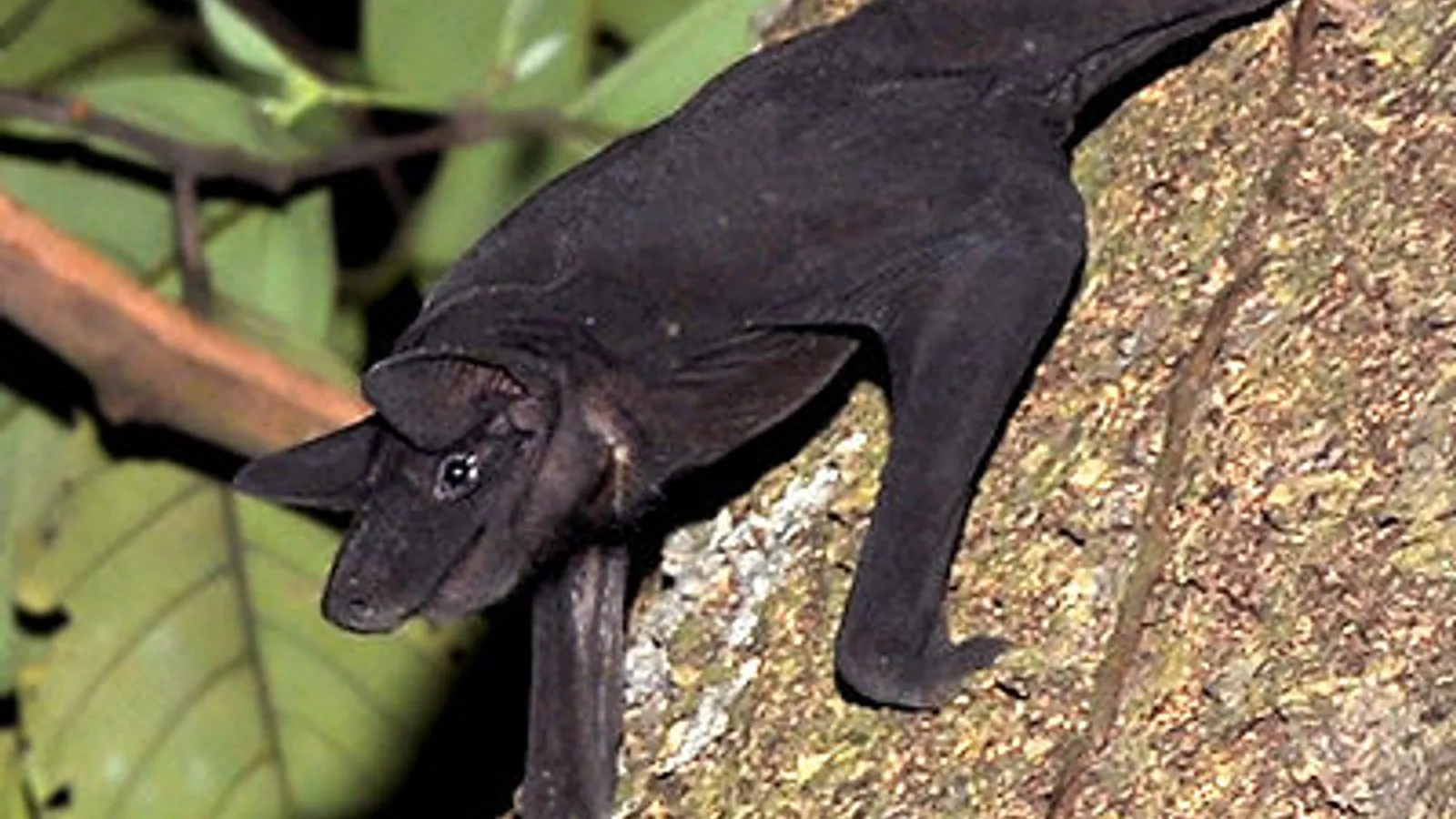
Cheiromeles joins the Greek cheír, “hand”, and mélos, “limb”: it alludes to the powerful thumbs and unusually strong hind legs, which this animal uses to walk and to climb. Torquatus is the Latin “collared”, for the ring of scent glands around the throat. The common name is all in the skin: it is practically naked, and the face is that of a fighting dog.
— Facts
- Group
- Mammals · Mammalia
- Order
- Bats
- Habitat
- Large tree hollows, caves, roofs; hunting above forest and cropland
- Range
- The Malay peninsula, Sumatra, Borneo, Java, the Philippines
- Size
- 11–14 cm of body, 55 cm wingspan, 150–200 g
- Diet
- Insectivore — winged termites and beetles, in swarms
- Lifespan
- Little known
— Characteristics
- 01
It is almost entirely hairless, a very rare condition among bats.
- 02
It has a pocket of skin along each flank into which it folds its wings when walking.
- 03
It is the heaviest insect-eating bat in the world.
— What sets it apart
It has a pocket to put its wings in. Along each flank runs a deep fold of skin, and when the animal moves on all fours — which it does often and well — it tucks the folded membranes inside, keeping them out of harm’s way and freeing the limbs for walking. No other bat has anything like it. Together with the naked skin and the mastiff’s face, it makes this the animal least like the common idea of a bat while being one in full.
