
Wallcreeper
Tichodroma muraria
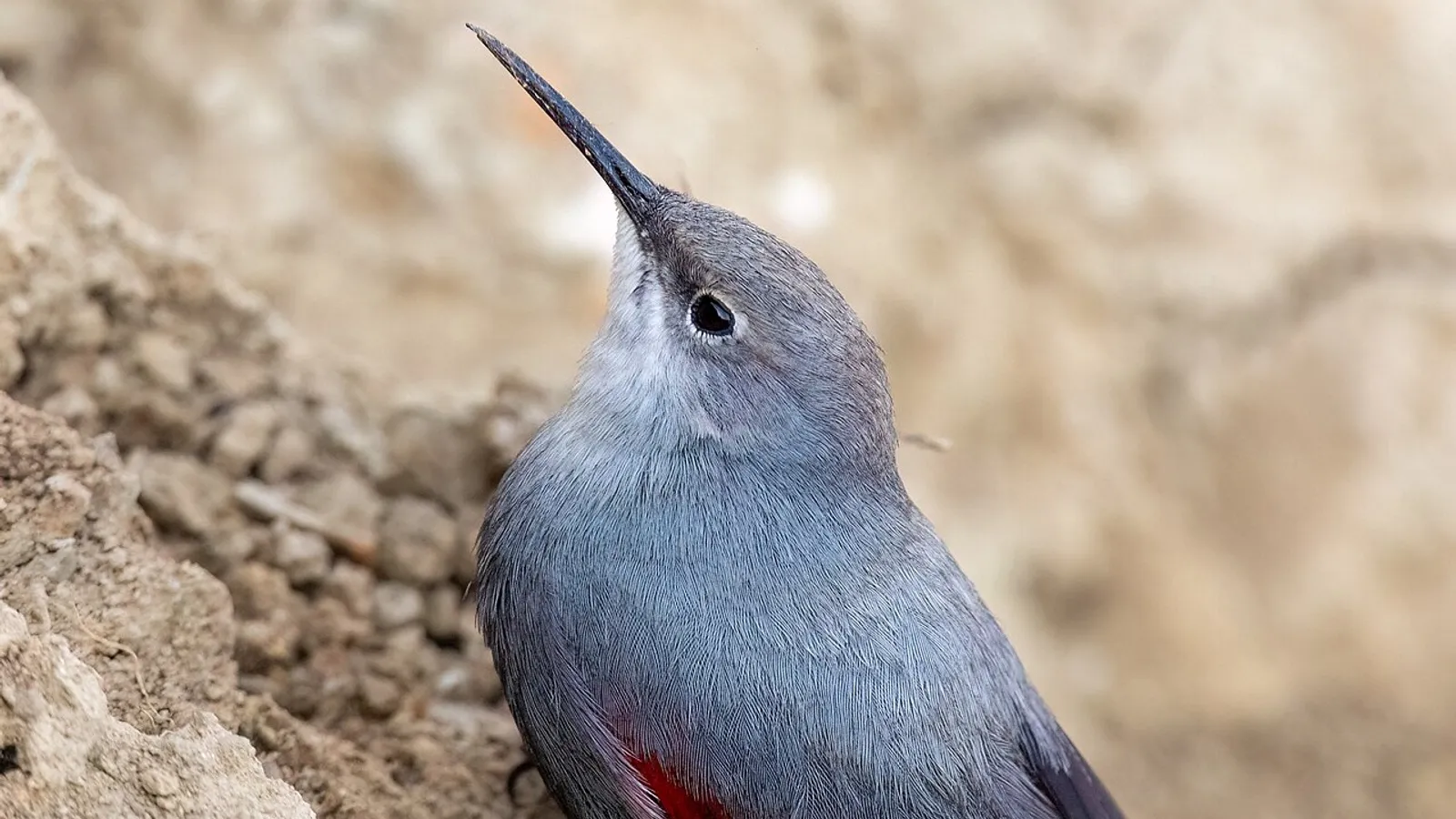
— Where the name comes from
Tichodroma joins the Greek teîchos, “wall”, and dromás, “runner”: “the wall-runner”. Muraria repeats the idea in Latin, “of walls”. The Italian name calls it a woodpecker, but it is not one: it is a songbird, the only member of its family, which climbs rock faces the way a woodpecker climbs trunks.
— Facts
- Group
- Birds · Aves
- Order
- Passerines
- Habitat
- Mountain cliffs and gorges; in winter quarries and buildings too
- Range
- The mountains of southern Europe and Asia, from the Pyrenees to the Himalaya and China
- Size
- 15–17 cm, 17–22 g
- Diet
- Insects, spiders and larvae prised out of crevices
- Lifespan
- A few years
— Characteristics
- 01
It has broad, rounded wings with large crimson patches.
- 02
It keeps flicking its wings open and shut as it climbs.
- 03
Its long, thin bill probes the narrowest cracks in the rock.
— What sets it apart
Climbing a sheer wall it looks like a nondescript grey bird, then it opens its wings and becomes a red butterfly: that is why it is often called the “butterfly of the rocks”. According to some observers the crimson flash also makes insects hidden in the crevices move, so that they give themselves away. In winter it comes down to lower ground and can be seen on the walls of old castles, churches and even city cathedrals, where it behaves just as it would on a rock face.