
Indo-Pacific sailfish
Istiophorus platypterus
— Where the name comes from
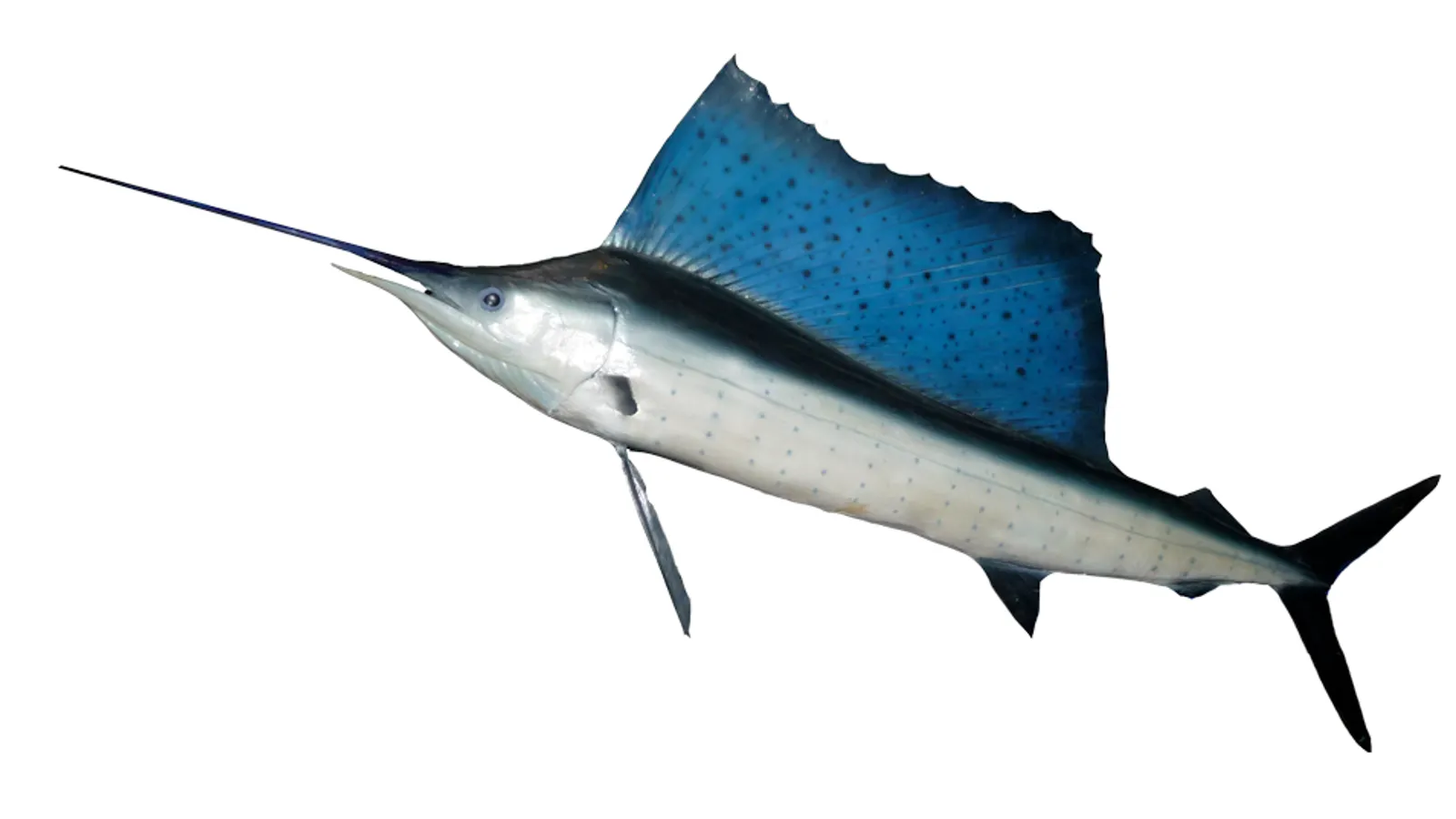
Istiophorus is Greek for “sail bearer”, from histíon, sail, and phérō, I carry: the huge dorsal fin it raises like a mainsail. Platypterus, “broad-finned”. The common name renders the same image. It is reckoned the fastest fish in the sea.
— Facts
- Group
- Fish · Actinopterygii · Chondrichthyes
- Order
- Billfishes
- Habitat
- Surface waters of the open sea
- Range
- Tropical and subtropical oceans
- Size
- 2–3 m, up to 3.5 m
- Diet
- Carnivore — shoaling fish and squid
- Lifespan
- 13–15 years
— Characteristics
- 01
The great sail-like dorsal fin usually lies folded and is raised to manoeuvre or to hunt.
- 02
It changes colour in a flash, lighting up with blue stripes, to signal during group hunts.
- 03
It is often named the fastest fish, with bursts said to pass 100 km/h.
— What sets it apart
The sailfish hunts in teams and “talks” in colour: when a group surrounds a shoal of sardines, individuals light up with iridescent blue striping that flashes on and off, a signal that seems to coordinate the attacks and to keep them from wounding one another with their bills. Then they raise the great dorsal sail to form a barrier that tightens around the shoal. It is one of the few proofs of cooperative hunting communicated through colour change among open-sea fish.
