
Common remora
Remora remora
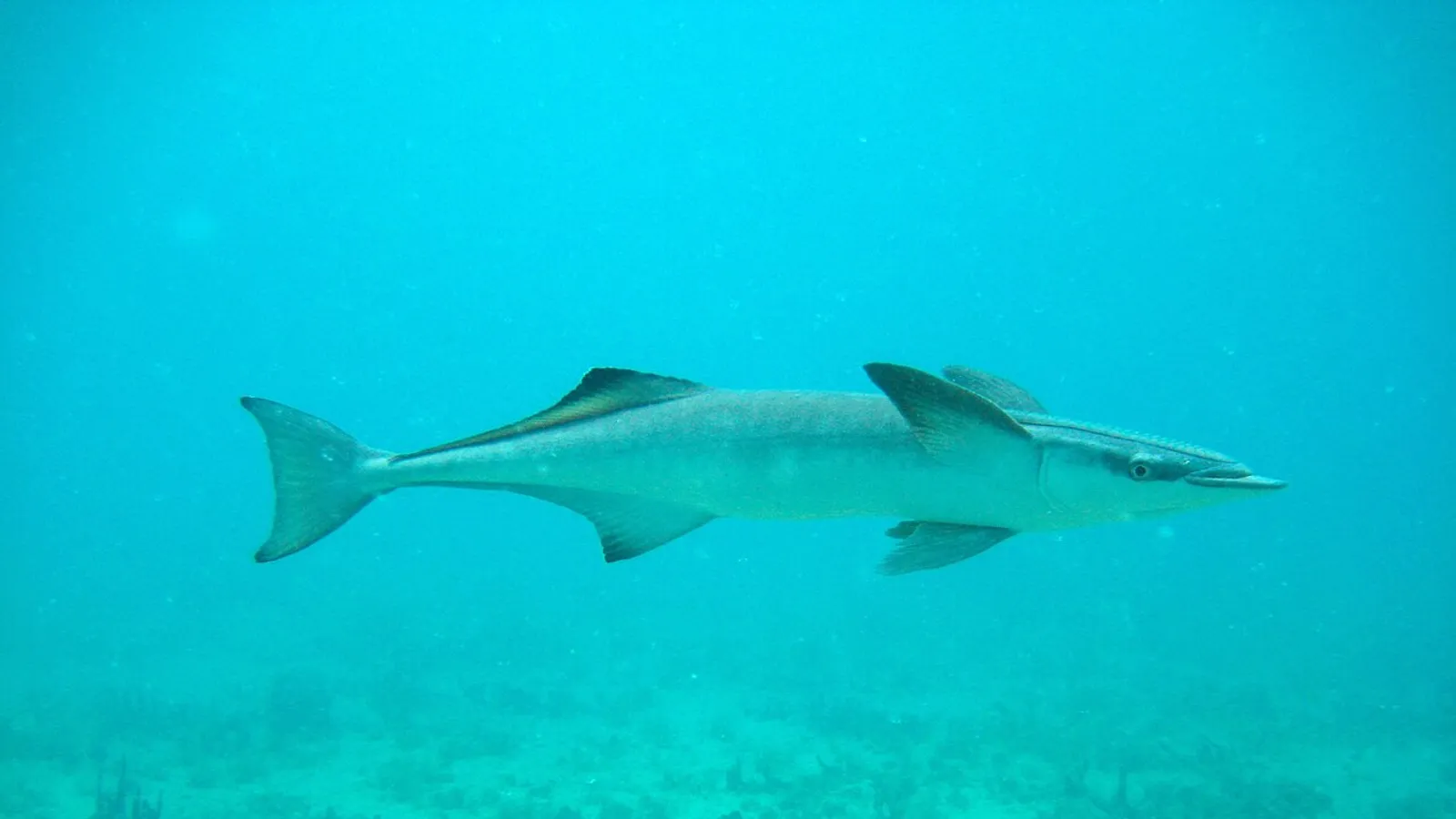
— Where the name comes from
Remora in Latin means “delay, hindrance”, and the name arises from the ancient belief that these fish could stop ships by fastening to the hull; the binomial repeats it twice. It is one of the few cases in which a word of ordinary vocabulary — a remora, an impediment — comes directly from an animal’s name.
— Facts
- Group
- Fish · Actinopterygii · Chondrichthyes
- Order
- Jacks and allies
- Habitat
- Attached to sharks and large fish in the open sea
- Range
- Tropical and temperate seas worldwide
- Size
- 30–60 cm, 500 g–1.2 kg
- Diet
- Parasites of the host, scraps, faeces, plankton
- Lifespan
- 5 years
— Characteristics
- 01
It attaches almost exclusively to sharks, more rarely to other animals.
- 02
The adhesive disc has movable lamellae whose grip increases with pull.
- 03
It does no harm to its host: it eats its parasites and its leavings.
— What sets it apart
In Cuba, Mozambique, Australia and the Gulf of Mexico fishermen used remoras for centuries as a living hook: a line is tied to the animal’s tail and it is thrown into the water near a turtle or a large fish, the remora fastens on and will not let go, and then you pull. Christopher Columbus described it on his second voyage, and anthropologists documented the technique still in use in the twentieth century. It is one of very few cases in which a fish has been used as fishing tackle.
