
Giant oarfish
Regalecus glesne
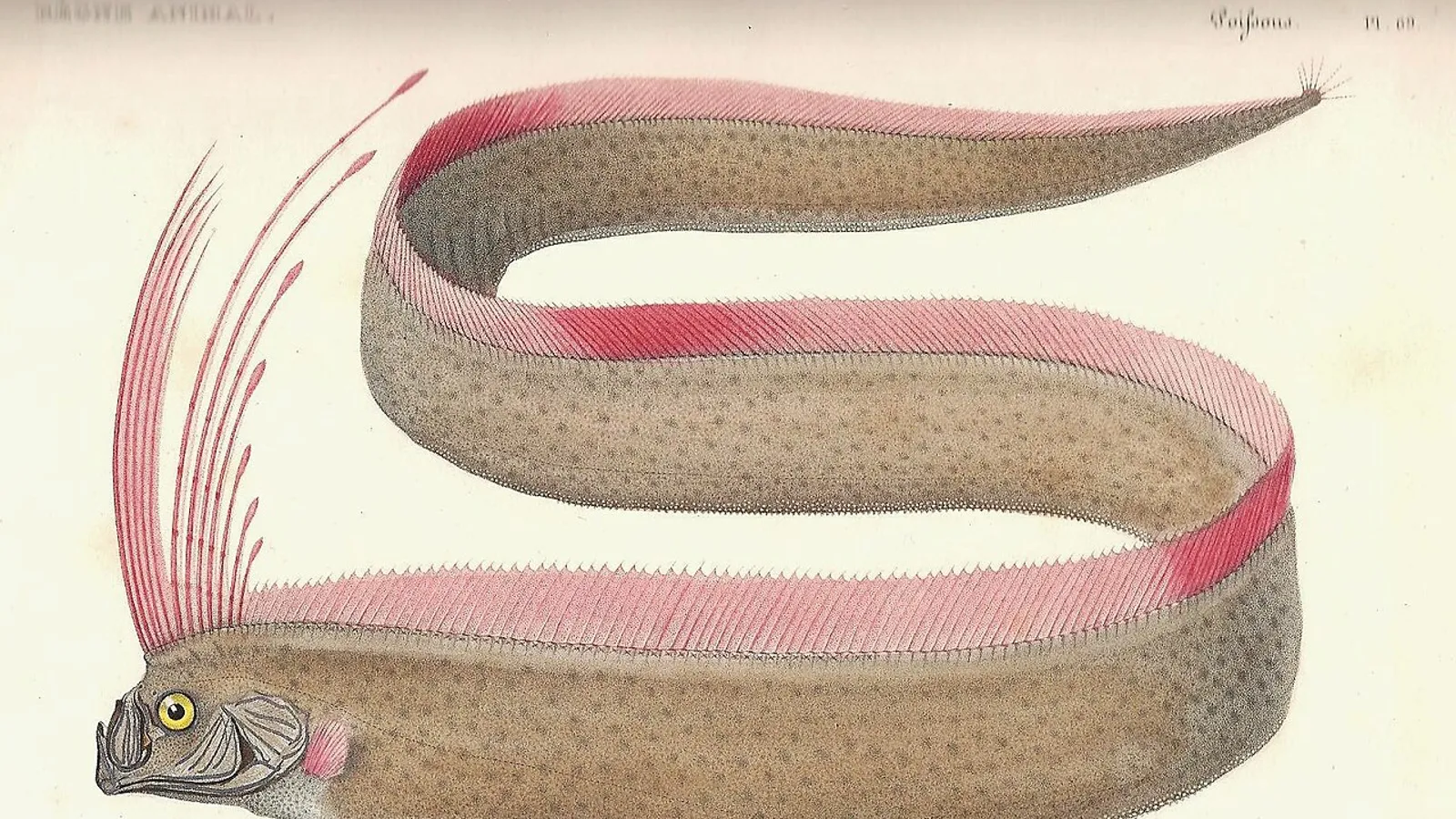
— Where the name comes from
Regalecus comes from the Latin regalis, “royal”, for the red crest on the head that earned it the English name king of herrings; glesne from the Norwegian locality where it was described. “Oarfish” for the very long, ribbon-like body. It is the longest bony fish in the world.
— Facts
- Group
- Fish · Actinopterygii · Chondrichthyes
- Order
- Lampriforms
- Habitat
- Open sea, at depths between 200 and 1,000 m
- Range
- All temperate and tropical oceans
- Size
- Commonly 3 m, up to 8 m and beyond
- Diet
- Filter-carnivore — krill, small crustaceans, squid
- Lifespan
- Unknown
— Characteristics
- 01
It is the longest living bony fish: some specimens pass eight metres.
- 02
It swims vertically, motionless, rippling its long red dorsal fin.
- 03
It lives in the depths and comes to the surface only when sick or dying.
— What sets it apart
The oarfish is behind most of the legends of “sea serpents”: its silvery body several metres long, with a red crest and an undulating movement, is exactly what sailors described on sighting serpentine monsters. It lives in the dark of the deep and rises almost only when dying, so that nearly every encounter is with a failing animal. In Japan it is tied to a persistent belief: it is said to appear on beaches shortly before earthquakes, a messenger from the abyss.
