
Guppy
Poecilia reticulata
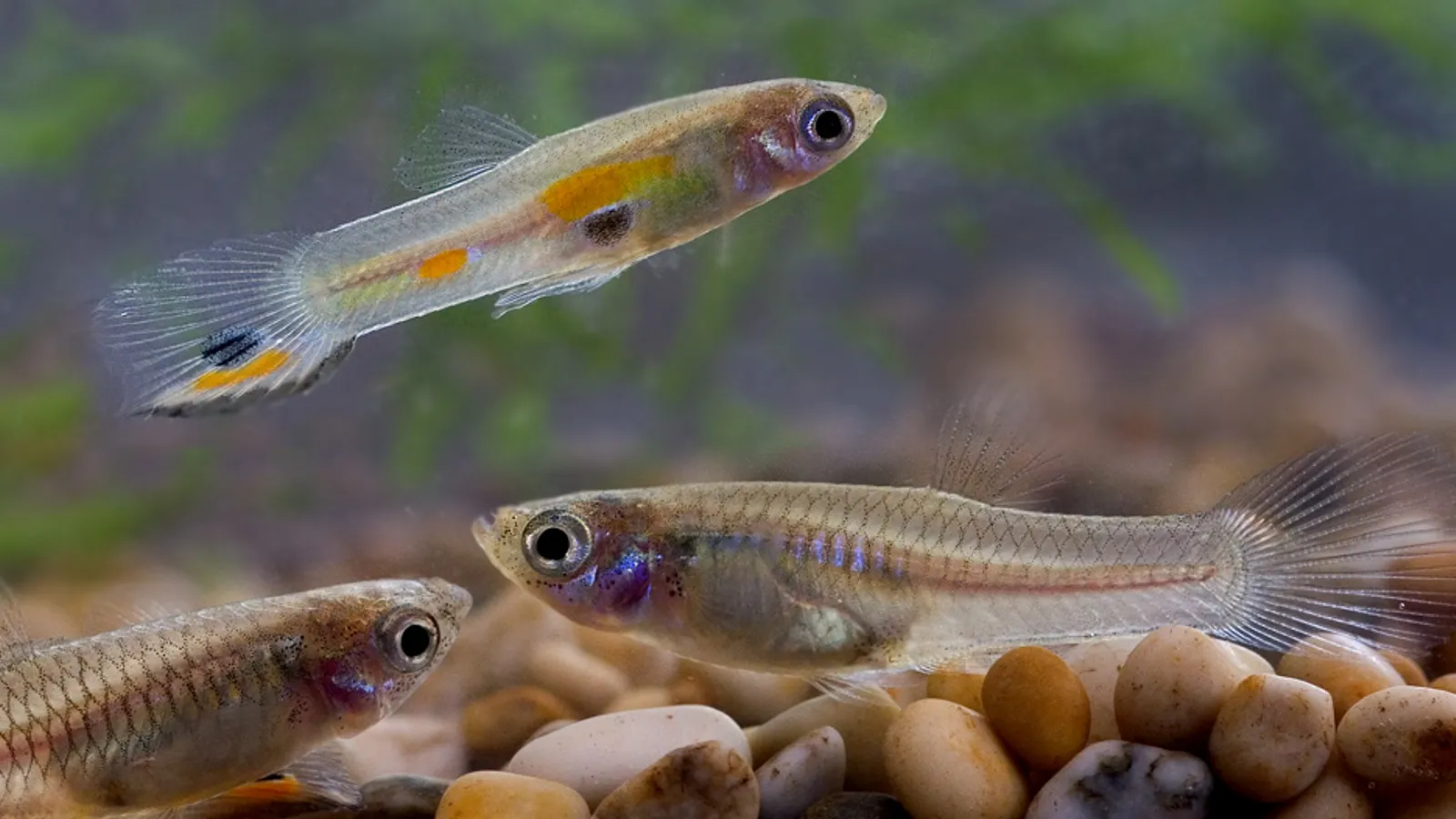
— Where the name comes from
Poecilia comes from the Greek poikílos, “dappled, many-coloured”; reticulata describes the net-like pattern of the flanks. Guppy recalls Robert John Lechmere Guppy, a colonial official in Trinidad who in 1866 sent specimens to the British Museum: the fish had already been described, but the man’s name stuck anyway.
— Facts
- Group
- Fish · Actinopterygii · Chondrichthyes
- Order
- Killifishes and livebearers
- Habitat
- Streams, drainage ditches, pools, even very dirty water
- Range
- Native to Trinidad and northern South America; introduced everywhere
- Size
- males 2–3 cm, females 4–6 cm; 0.1–0.3 g
- Diet
- Algae, mosquito larvae, detritus
- Lifespan
- 2 years
— Characteristics
- 01
It bears live young instead of laying eggs.
- 02
Males are tiny and gaudy, females large and grey.
- 03
It has been spread across half the world to control mosquitoes.
— What sets it apart
It is the animal on which evolution has been watched happening in real time. The streams of Trinidad have reaches with predators and reaches above waterfalls where predators do not reach, and in the first the males are grey and mature early, in the second they are gaudy and grow slowly. Moving fish from one reach to the other, researchers watched colour and maturation times change within about ten generations, that is in two years. It is perhaps the most cited experimental demonstration of natural selection after the moths of Manchester.
