
Platypus
Ornithorhynchus anatinus
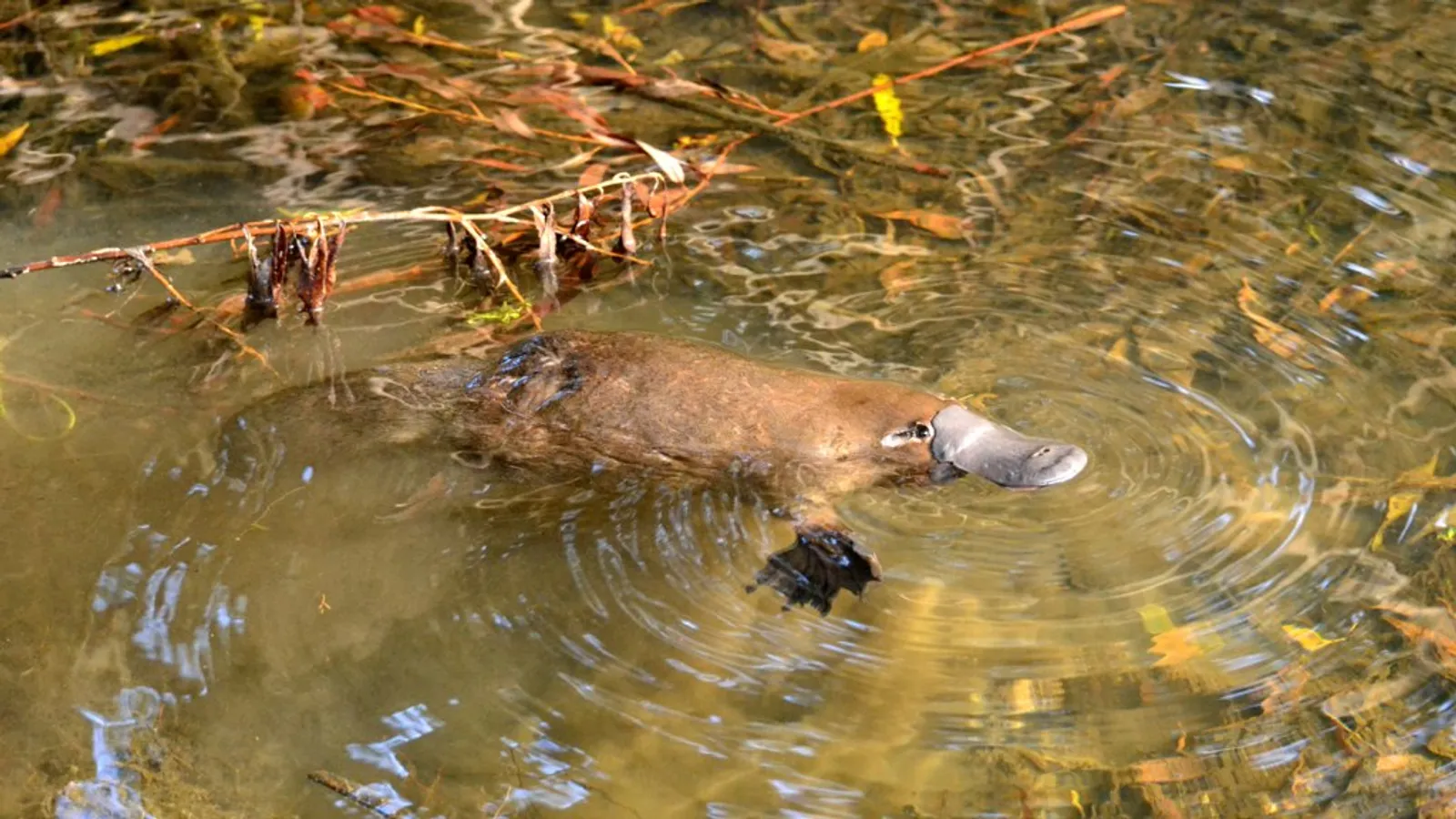
— Where the name comes from
From the Greek ornithórynkhos, “bird beak” (órnis, bird + rhýnkhos, beak), with the Latin anatinus, “duck-like”. The name is pure bewilderment: the first European naturalists to receive a stuffed specimen took it for a fake sewn together from parts.
— Facts
- Group
- Mammals · Mammalia
- Order
- Monotremes
- Habitat
- Freshwater rivers and streams
- Range
- Eastern Australia and Tasmania
- Size
- 40–50 cm, 0.7–2.4 kg
- Diet
- Carnivore — larvae, shrimp, worms gathered off the bottom
- Lifespan
- about 12 years
— Characteristics
- 01
A mammal that lays eggs, as only the echidnas otherwise do.
- 02
The male has a venomous spur on the hind leg.
- 03
It has no stomach: the oesophagus opens straight into the intestine.
— What sets it apart
It hunts with its eyes, ears and nostrils shut. The bill is a sense organ: 40,000 electroreceptors read the minute electric fields thrown off by the muscle contractions of its prey, and 60,000 mechanoreceptors read their movement through the water. By comparing the lag between the two signals, the platypus works out the distance — a sonar that uses no sound.
