
Northern nutcracker
Nucifraga caryocatactes
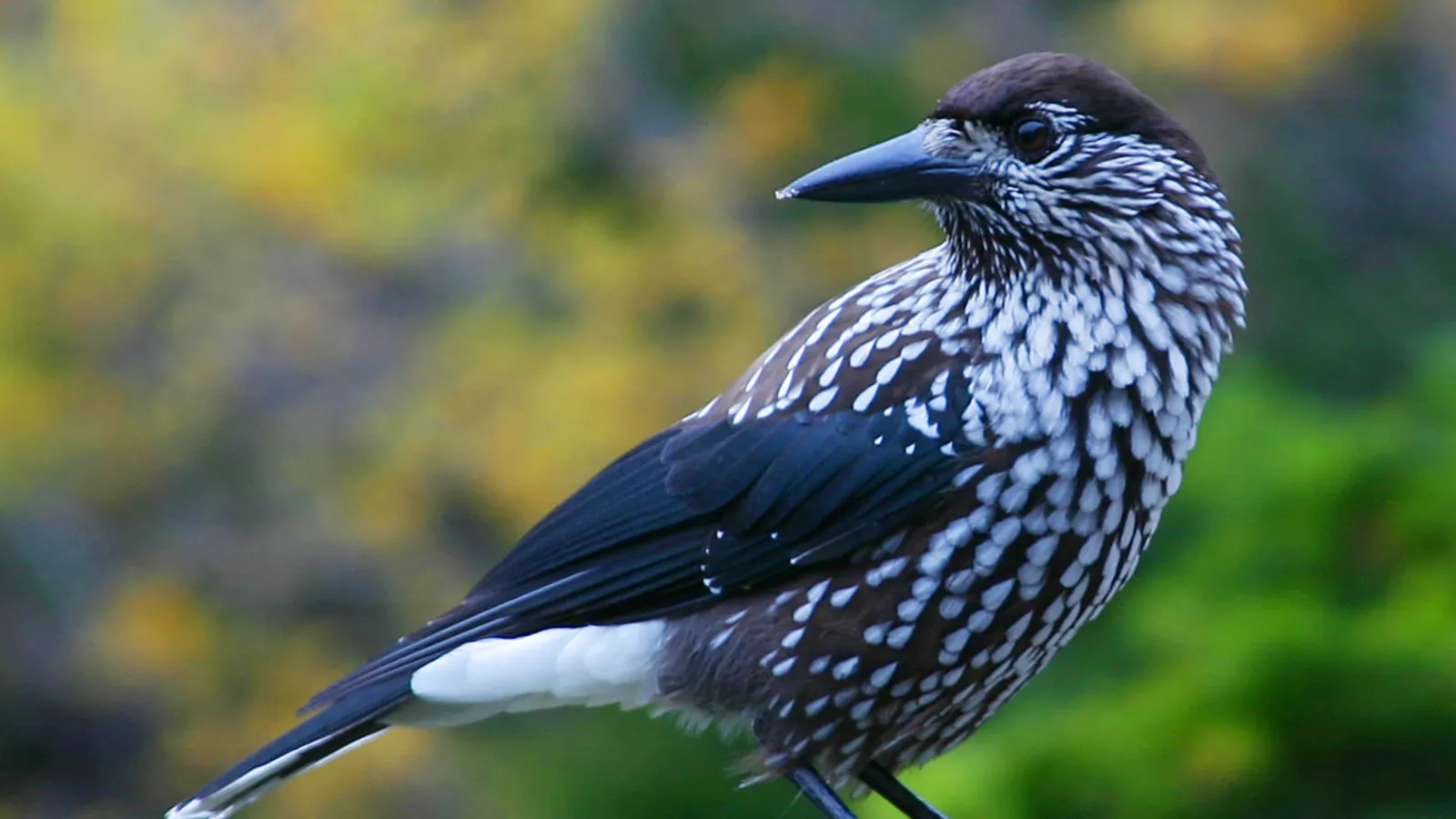
— Where the name comes from
The binomial says “nutcracker” twice, in two languages: Nucifraga is Latin, from nux and frangere, and caryocatactes is Greek, from káryon and katagnymi. Linnaeus took the Greek name the ancients used and put the Latin translation in front of it, producing a scientific name that is a perfect repetition.
— Facts
- Group
- Birds · Aves
- Order
- Passerines
- Habitat
- Mountain conifer forest, Arolla pine and spruce woods
- Range
- The Alps, Carpathians, Scandinavia, Siberia as far as Japan
- Size
- 32–35 cm, wingspan 49–53 cm, 150–200 g
- Diet
- Arolla pine nuts, hazelnuts, insects, eggs
- Lifespan
- 10 years in the wild
— Characteristics
- 01
It has a pouch under the tongue that carries up to a hundred pine nuts.
- 02
It hides its stores in thousands of separate spots under soil and moss.
- 03
It nests in March, on snow, living on what it buried in autumn.
— What sets it apart
It buries up to a hundred thousand pine nuts in one autumn and finds the ones it needs again months later under half a metre of snow, navigating by boulders and trunks as though they were fixed points on a map. It still forgets thousands, and those germinate: the Arolla pine has seeds too heavy for the wind, and without this bird it would not climb the mountains. In many Alpine valleys the upper limit of the forest is, quite literally, the limit up to which a nutcracker felt like carrying the seeds.
