
Common bent-wing bat
Miniopterus schreibersii
— Where the name comes from
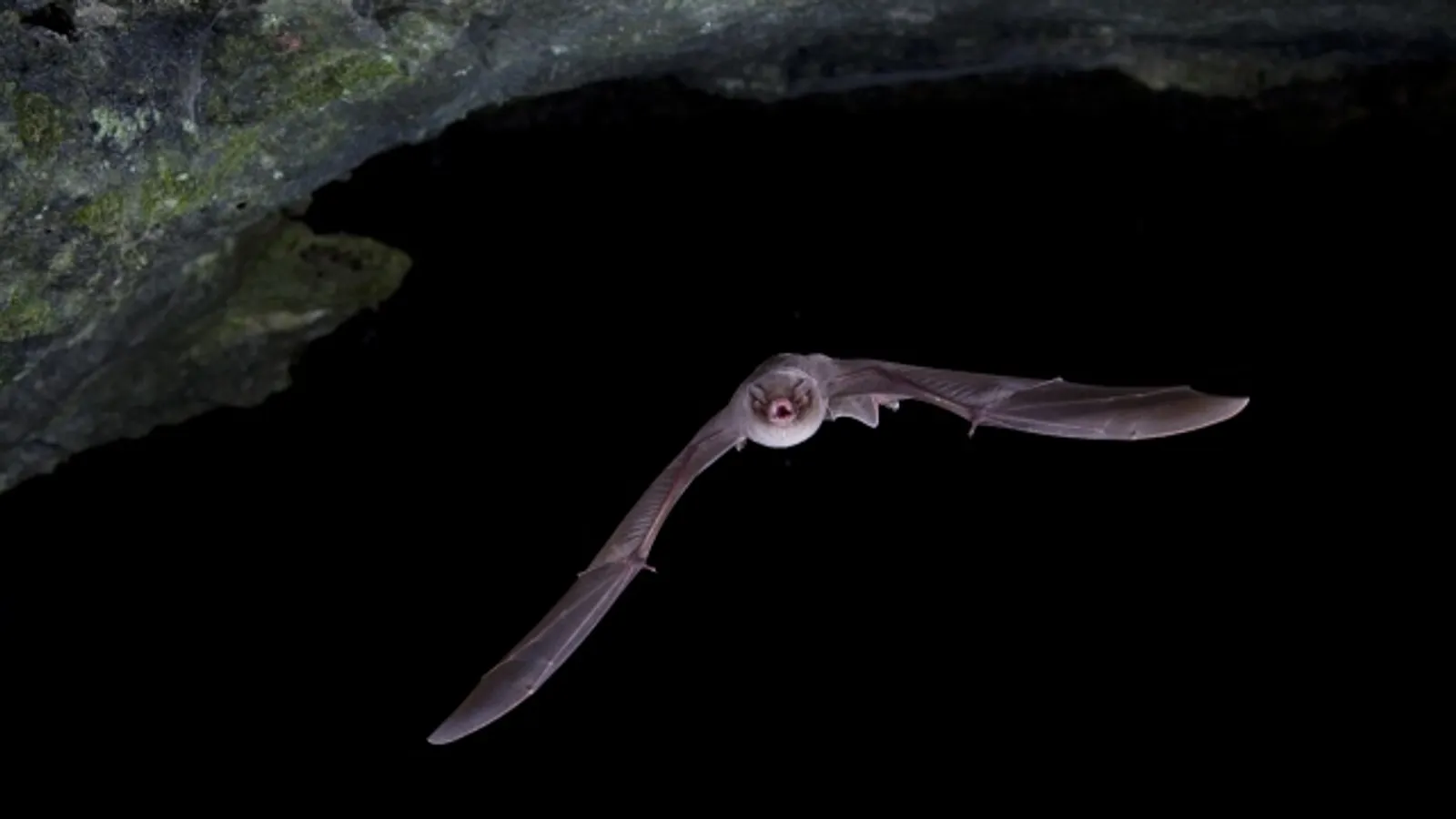
Miniopterus is built on the Latin minor and the Greek pterón, “small wing”, but the reference is to a precise detail: the first phalanx of the third finger is very short and the second very long, so that at rest the wing folds back on itself like a carpenter’s rule. Schreibersii recalls Karl von Schreibers, director of the natural history museum in Vienna in the early 19th century.
— Facts
- Group
- Mammals · Mammalia
- Order
- Bats
- Habitat
- Caves, tunnels and mines; hunting in open air and above woodland
- Range
- Southern Europe, North Africa, Asia Minor and the Caucasus
- Size
- 5–6.3 cm of body, 30 cm wingspan, 9–16 g
- Diet
- Insectivore — moths and small insects in high, fast flight
- Lifespan
- Up to 16 years
— Characteristics
- 01
Wintering colonies gather tens of thousands of animals in a few caves.
- 02
It flies fast and high, on long tapered wings like a swift’s.
- 03
It moves seasonally for hundreds of kilometres between different caves.
— What sets it apart
The female mates in autumn and gives birth in June, but she does not store the sperm as other European bats do: here fertilisation happens at once and it is the embryo that is suspended, halting at the blastocyst stage and not implanting in the uterus until spring arrives. It is called embryonic diapause, it is the same strategy as the roe deer’s and the bear’s, and it is the only case among European bats — all the others solved the same problem by storing semen instead of the embryo.
