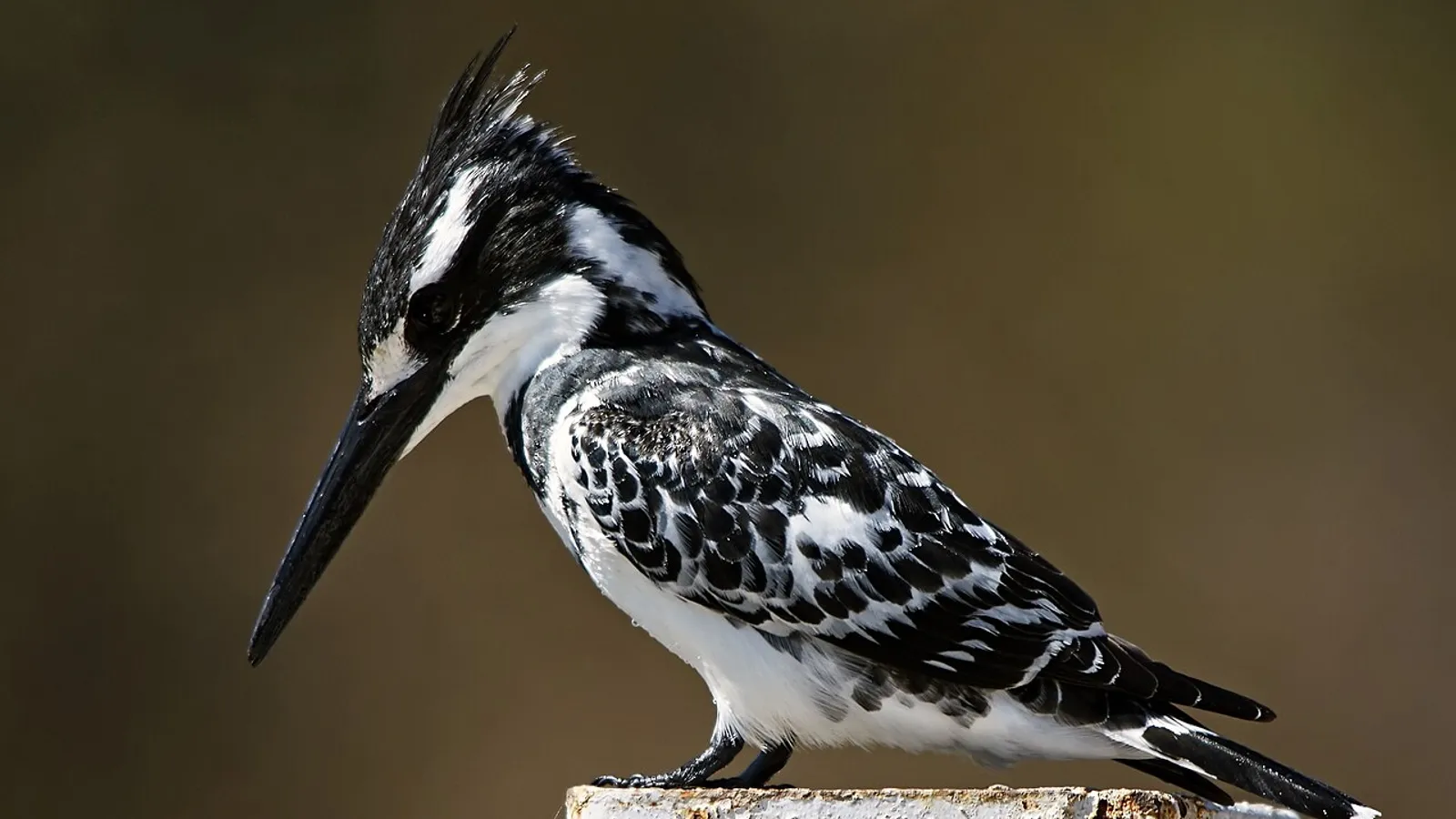
Pied kingfisher
Ceryle rudis
— Where the name comes from
Ceryle comes from kērýlos, a legendary sea bird that the Greek poet Alcman names as the male of the halcyon. Rudis in Latin means “rough, unpolished”, perhaps because its black-and-white plumage seemed plain beside the colours of the common kingfisher.
— Facts
- Group
- Birds · Aves
- Order
- Rollers and kingfishers
- Habitat
- Lakes, slow rivers, estuaries, coastal lagoons
- Range
- Sub-Saharan Africa, the Middle East, India and southern China
- Size
- 25 cm, 70–100 g
- Diet
- Small fish, crustaceans, aquatic insects
- Lifespan
- Not precisely known in the wild
— Characteristics
- 01
It hangs in mid-air above the water before diving.
- 02
The male has two black bands across the breast, the female one, broken.
- 03
It can eat small fish in flight, without returning to a perch.
— What sets it apart
It is the largest bird able to hover in still air, and this lets it fish far from the shore, where other kingfishers, which dive from a branch, cannot reach. In the 1980s the biologist Uwe Reyer studied its colonies in Kenya and discovered a system of helpers at the nest: some are offspring from earlier years helping their parents, others are unrelated males bringing fish to someone else’s chicks. The latter are not doing it out of kindness: the following year, often, they are the ones that mate with the female they helped.