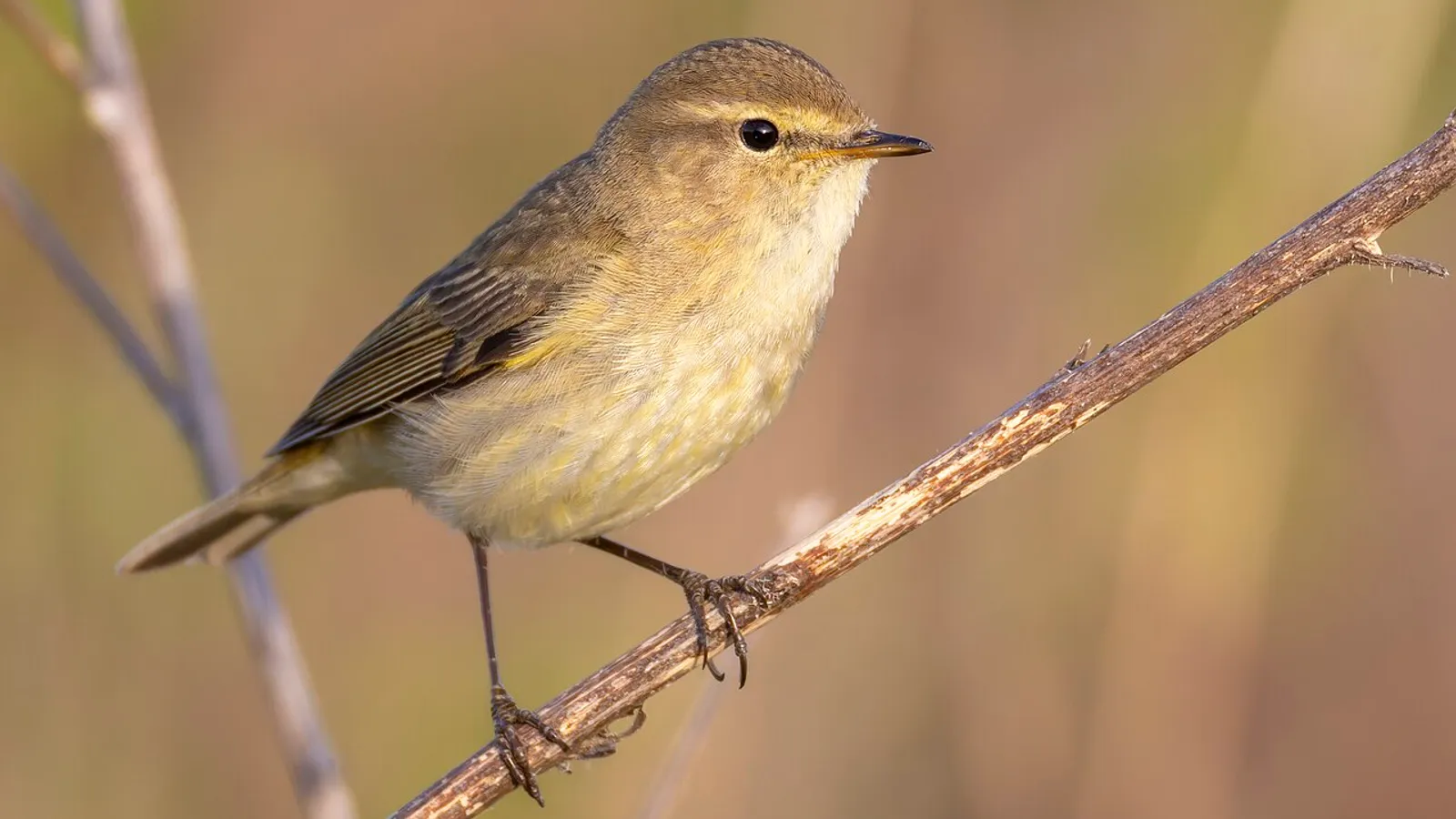
Common chiffchaff
Phylloscopus collybita
— Where the name comes from
Phylloscopus joins the Greek phýllon, “leaf”, and skopéō, “to watch”: “the one who searches the leaves”, as it does, moving restlessly through the branches in search of insects. Collybita comes from kollybistḗs, the money-changer: the song, two notes alternated and repeated, recalled the chink of coins counted on the counter. The Italian luì and the English chiffchaff also imitate the bird’s voice.
— Facts
- Group
- Birds · Aves
- Order
- Passerines
- Habitat
- Woodland, hedgerows, parks and wooded gardens
- Range
- Europe and western Asia; winters in the Mediterranean and Africa
- Size
- 10–12 cm, 6–11 g
- Diet
- Small insects and spiders
- Lifespan
- 2–3 years on average
— Characteristics
- 01
It is olive-green and almost identical to other leaf warblers: it is told apart by its song.
- 02
It dips its tail with small, constant flicks.
- 03
It is one of the first birds to sing in spring.
— What sets it apart
It is the bird that taught ornithologists to listen. In the eighteenth century the chiffchaff, the willow warbler and the wood warbler passed for a single species, because by sight they are almost impossible to separate. It was the English parson Gilbert White, in his Natural History of Selborne, who noticed that they sang in three entirely different ways, and concluded that they were three distinct birds. Since then song has become one of the main criteria for recognising species, and for many small songbirds it remains the most reliable.