
Norway lemming
Lemmus lemmus
— Where the name comes from
Lemmus latinises the Norwegian lemen, of old Scandinavian origin and perhaps related to a root meaning “to bark” or “to wail”. In 16th-century Scandinavia lemmings were believed to fall from the sky with the rain, because they appeared suddenly in millions: Olaus Magnus wrote it as fact in 1555, and the naturalist Ole Worm had to refute it in print a century later.
— Facts
- Group
- Mammals · Mammalia
- Order
- Rodents
- Habitat
- Tundra and high moorland, under the snow in winter
- Range
- The Scandinavian peninsula and north-western Russia
- Size
- 13–15 cm, 40–110 g
- Diet
- Herbivore — mosses, sedges, grasses
- Lifespan
- 1–2 years
— Characteristics
- 01
The population booms and crashes in cycles of three to five years, swinging a thousandfold.
- 02
In winter it lives and breeds in tunnels under the snow, rather than hibernating.
- 03
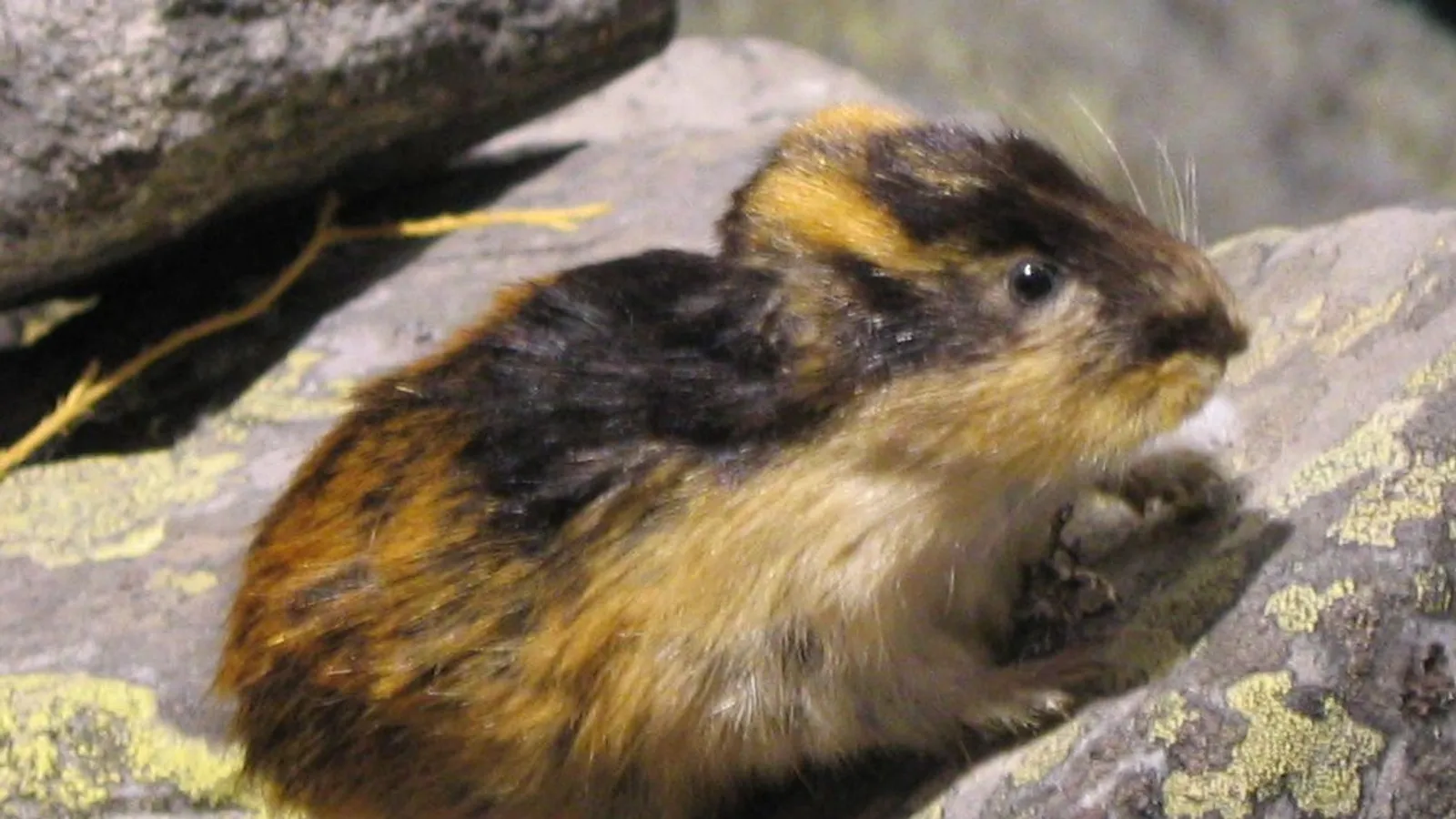
The conspicuous black and orange coat is a warning: it is aggressive and bites.
— What sets it apart
Lemming mass suicide does not exist, and we know exactly who invented it. It is a sequence from the Disney documentary White Wilderness of 1958, filmed in Alberta — where lemmings do not live — with animals bought from Inuit children, driven onto a turntable covered in snow and then thrown off a cliff into the Bow river. The film won an Oscar. In reality lemmings migrate en masse when density becomes unsustainable, and some drown crossing watercourses: none throw themselves off.
