
Blue wildebeest
Connochaetes taurinus
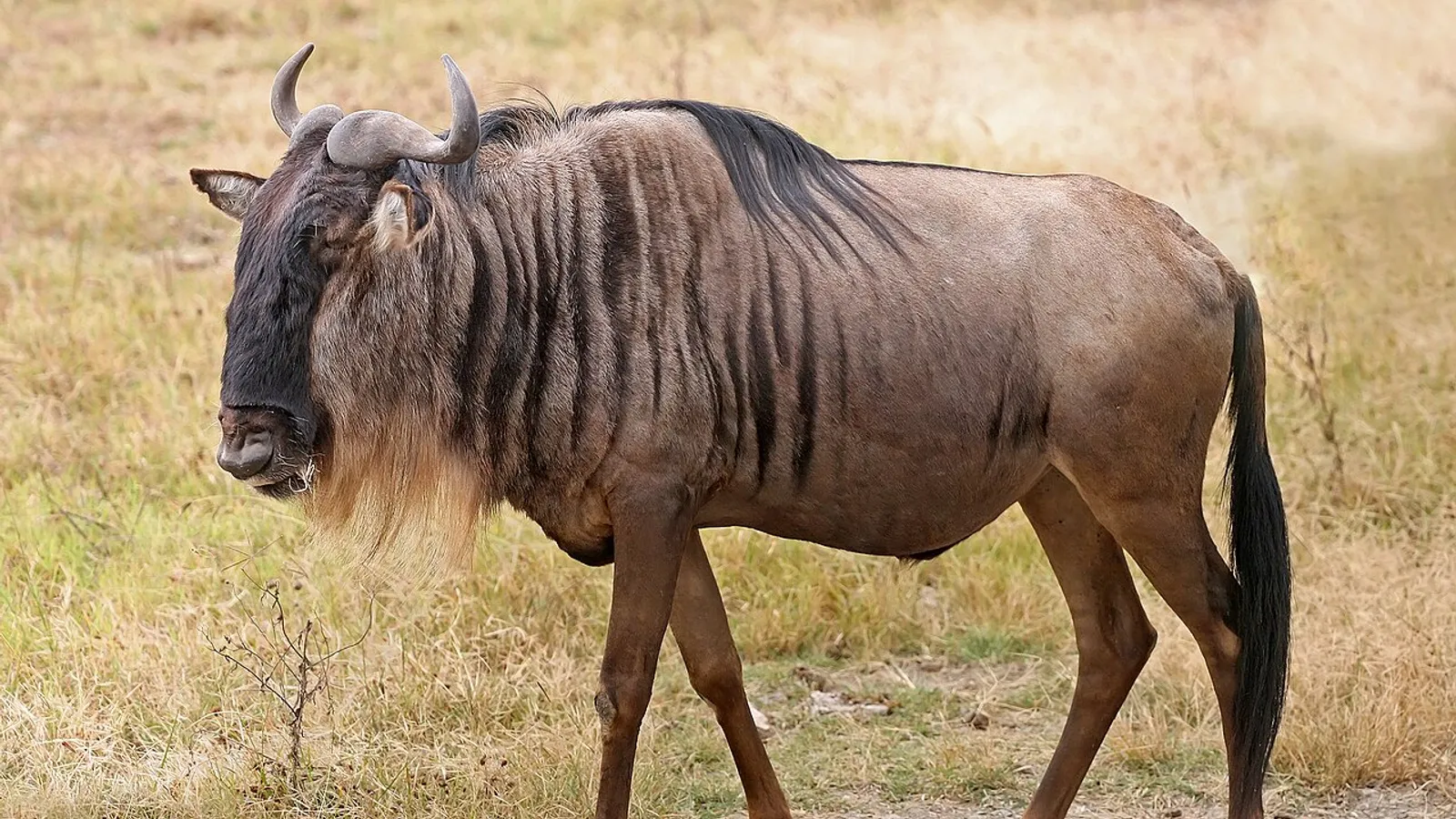
— Where the name comes from
Connochaetes is Greek for “bearded mane”, from kónnos, beard, and chaítē, hair. Taurinus is Latin, “bull-like”. “Gnu” imitates the animal’s call, a nasal lowing written down by the Khoikhoi as t’gnu. It is an antelope that looks assembled from the spare parts of other animals.
— Facts
- Group
- Mammals · Mammalia
- Order
- Even-toed ungulates
- Habitat
- Grassy savannah and open plains
- Range
- Eastern and southern Africa
- Size
- 170–240 cm, 120–270 kg
- Diet
- A grazing herbivore — short grass
- Lifespan
- 20 years
— Characteristics
- 01
Every year more than a million wildebeest make the Great Migration between the Serengeti and the Masai Mara.
- 02
The calves stand within minutes of birth and run with the herd within days.
- 03
It follows the rains and the new grass with a precision that looks like collective memory.
— What sets it apart
The wildebeest migration is governed by clouds: the herds sense distant storms and head for the rain and the fresh grass, tens of kilometres off. And the females nearly all calve within two or three weeks, spilling hundreds of thousands of young onto the savannah at once. It is a brutal, arithmetical tactic: the predators cannot kill them all, so the majority survive precisely because they are born together.
