
Common pond skater
Gerris lacustris
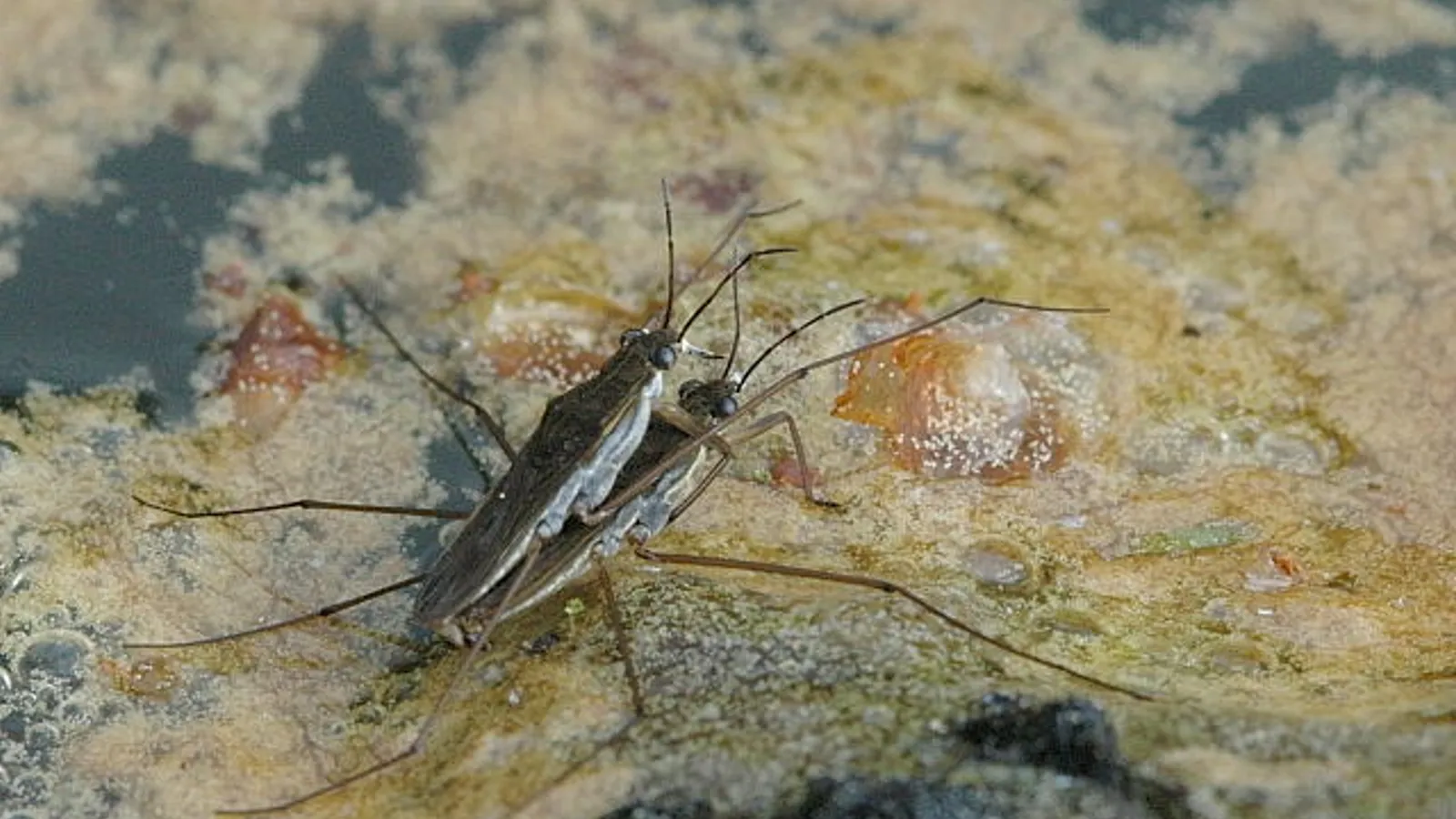
— Where the name comes from
Lacustris names the lake, and is the clear part of the name. It is the popular names, once again, that do the work: pond skater and water strider in English, patineur in French, Wasserläufer in German, “water skater” in Italian. All the languages of Europe looked at the same scene and chose the same verb — to skate, to walk, to run — on a surface that for these insects is solid.
— Facts
- Group
- Insects · Insecta
- Order
- True bugs
- Habitat
- The surface of ponds, backwaters and still water
- Range
- Europe and northern Asia
- Size
- 8–10 mm
- Diet
- Insects fallen into the water
- Lifespan
- 1 year; the adult overwinters on land
— Characteristics
- 01
The legs are covered with thousands of water-repellent hairs per millimetre.
- 02
The middle legs row, the hind legs steer, the front legs seize.
- 03
It feels surface vibrations and locates prey from the ripples.
— What sets it apart
It does not float: it stands on the skin of the water without breaking it. Each leg is clad in thousands of grooved, waxed micro-hairs that trap air and prevent direct contact, and the surface curves beneath the foot without giving way — the force that holds it up is surface tension, and the margin is wide, because the animal can bear fifteen times its own weight before breaking through. It hunts by reading ripples: an insect fallen into the water produces waves of characteristic frequency, and the skater derives direction and distance from them. It answers females, and calls them, by generating waves of its own with its legs.
