
Winter white dwarf hamster
Phodopus sungorus
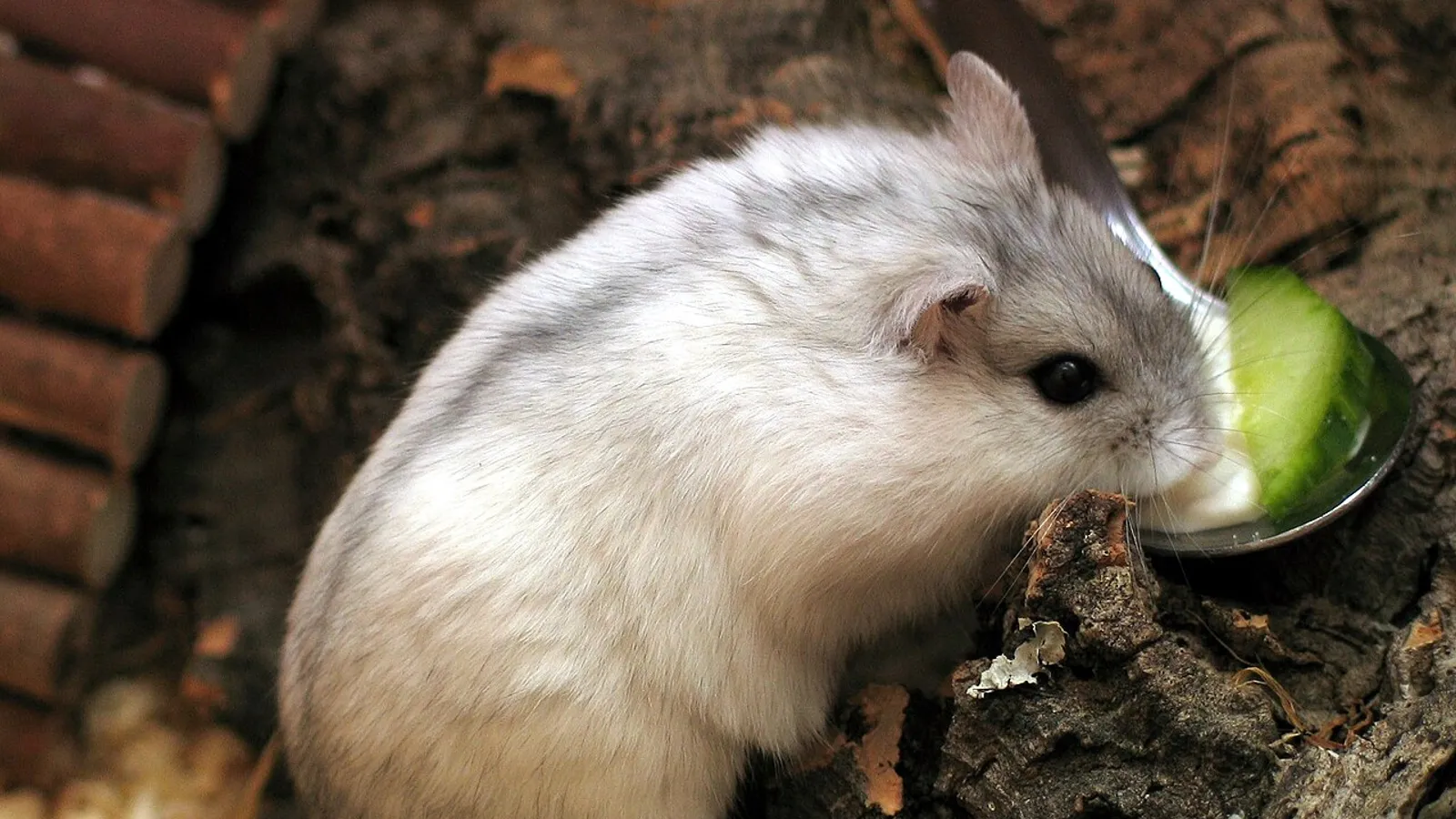
— Where the name comes from
Phodopus means “blister foot”, from the Greek phôdos, the blister or callus, and poús: the soles are covered in dense fur and look swollen, an adaptation against frozen sand. Sungorus points to Dzungaria, the region between the Altai and the Tian Shan that was the last great Mongol khanate, destroyed by the Qing in the 18th century.
— Facts
- Group
- Mammals · Mammalia
- Order
- Rodents
- Habitat
- Dry steppe, grassland, fields
- Range
- Southern Siberia, eastern Kazakhstan, Dzungaria
- Size
- 7–10 cm, 19–45 g
- Diet
- Seeds, shoots, insects
- Lifespan
- 2 years
— Characteristics
- 01
In winter the fur turns almost entirely white, but for the dark line down the back.
- 02
It enters daily torpor to save energy on cold nights.
- 03
The females can conceive again within hours of giving birth.
— What sets it apart
Its change of coat depends only on day length, not on cold, and that has made it a laboratory animal for the study of melatonin. Kept on short days at twenty-five degrees in a cage, it whitens all the same; kept under summer light at Arctic temperatures, it stays grey. It is the clearest demonstration that many mammals read the season not from the thermometer but from the clock.
