Ruff
Calidris pugnax
— Where the name comes from
Calidris comes from kalidrís, a grey, speckled waterbird mentioned by Aristotle and never identified with certainty. Pugnax in Latin means “combative”, like the Italian combattente, “fighter”: in spring the males face off in ritual duels in their courtship arenas.
— Facts
- Group
- Birds · Aves
- Order
- Shorebirds
- Habitat
- Tundra marshes and wet grassland; wetlands and rice fields on migration
- Range
- Breeds in northern Eurasia; winters in Africa and southern Asia, passes through Italy
- Size
- Male 29–32 cm and 150–230 g, female 22–26 cm and 70–150 g
- Diet
- Insects and larvae, worms, seeds
- Lifespan
- Over 10 years
— Characteristics
- 01
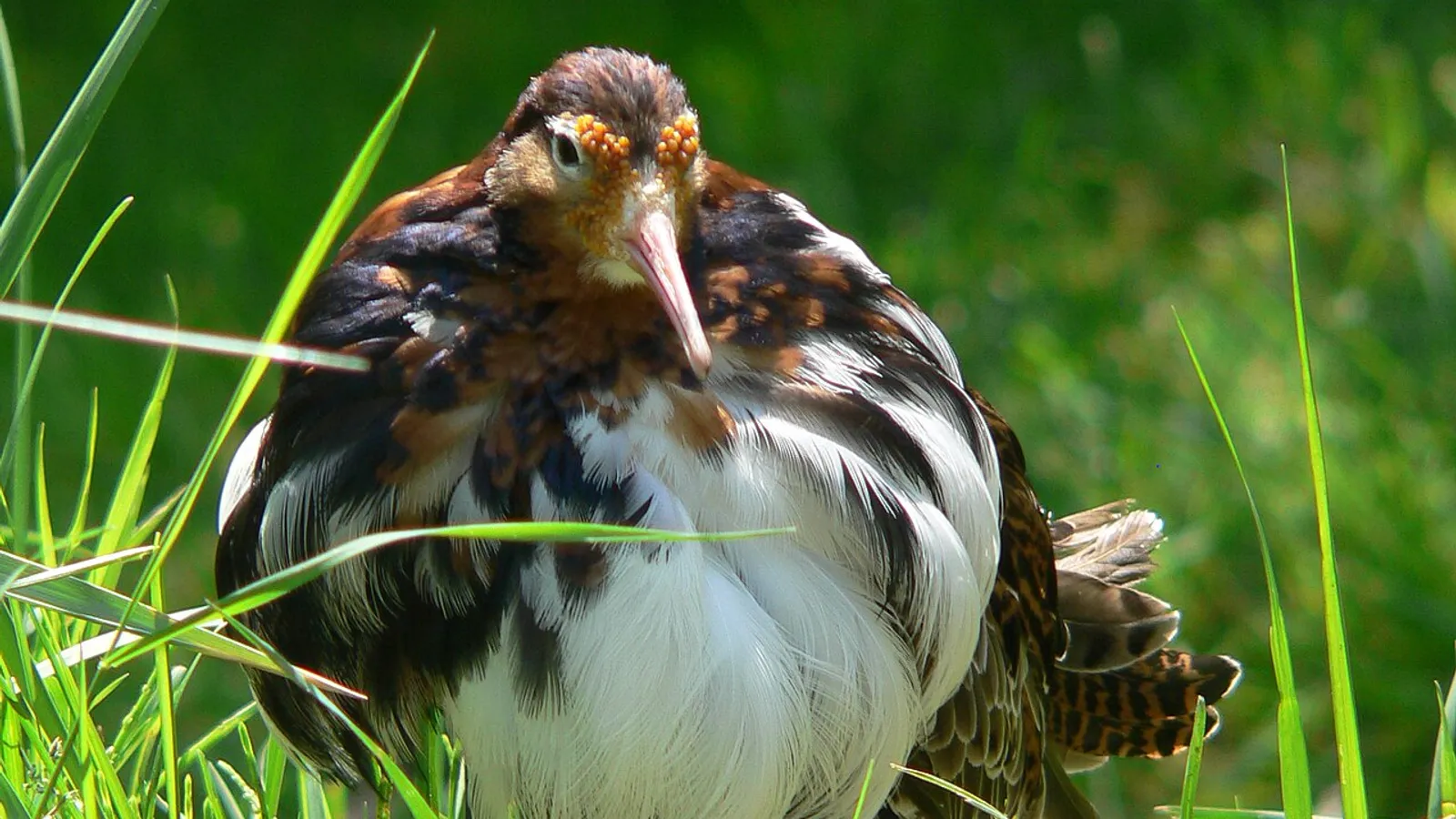
In spring the male shows off a ruff of puffed-up feathers, different in every bird.
- 02
Males display in communal arenas where the females choose whom to mate with.
- 03
The male is nearly twice the size of the female.
— What sets it apart
The males come not in one type but in three, and the difference is written in their DNA. “Independents” have a dark ruff and defend a patch of the arena; “satellites”, with a white ruff, do not fight and hover round the independents to steal matings; and “faeders”, discovered only in 2006, are males without a ruff that look in every respect like females and slip into the arena undisturbed. In 2015 it was found that the three strategies depend on a block of genes flipped on a chromosome, inherited as a unit for millions of years.