
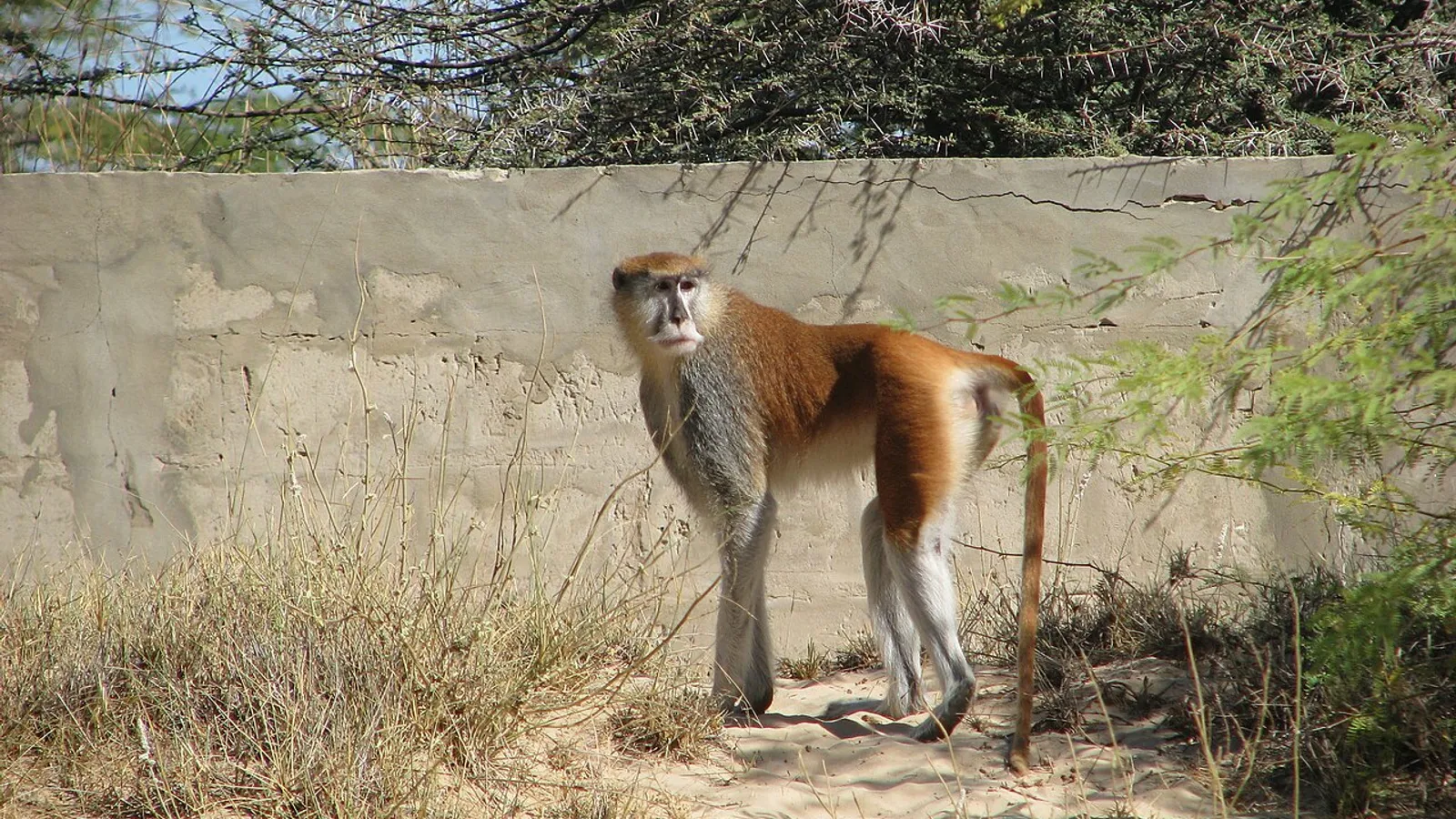
Common patas monkey
Erythrocebus patas
— Where the name comes from
Erythrocebus is “red monkey”, from the Greek erythrós and kêbos, the word the ancients used for long-tailed monkeys. Patas comes from a West African language, probably Wolof, gathered by French naturalists in Senegal. In English it is also the hussar monkey, for the tawny coat and white whiskers that recall that cavalry’s uniform.
— Facts
- Group
- Mammals · Mammalia
- Order
- Primates
- Habitat
- Open savannah, shrubby steppe, semi-desert
- Range
- The Sahel and Sudanian belt, from Senegal to Ethiopia and Tanzania
- Size
- 60–87 cm of body, 7–13 kg
- Diet
- Omnivore — acacia gum, seeds, fruit, insects, eggs
- Lifespan
- 20 years in the wild
— Characteristics
- 01
It runs at 55 km/h: the fastest primate in the world.
- 02
It has long slender legs, a narrow chest, and runs on its fingers alone: a sprinter’s build.
- 03
It sleeps in a different tree every night, scattering rather than gathering.
— What sets it apart
It is the primate that chose flight over trees. Living on open savannah, where refuges are few and far apart, it has reshaped its body around a single problem — reaching the next tree before the predator does — and has managed it by becoming the fastest of all. Its night-time strategy follows suit: instead of massing in a common roost as baboons do, the group scatters into different trees every night, so that a predator finding one does not find the rest.
