
Brown centipede
Lithobius forficatus
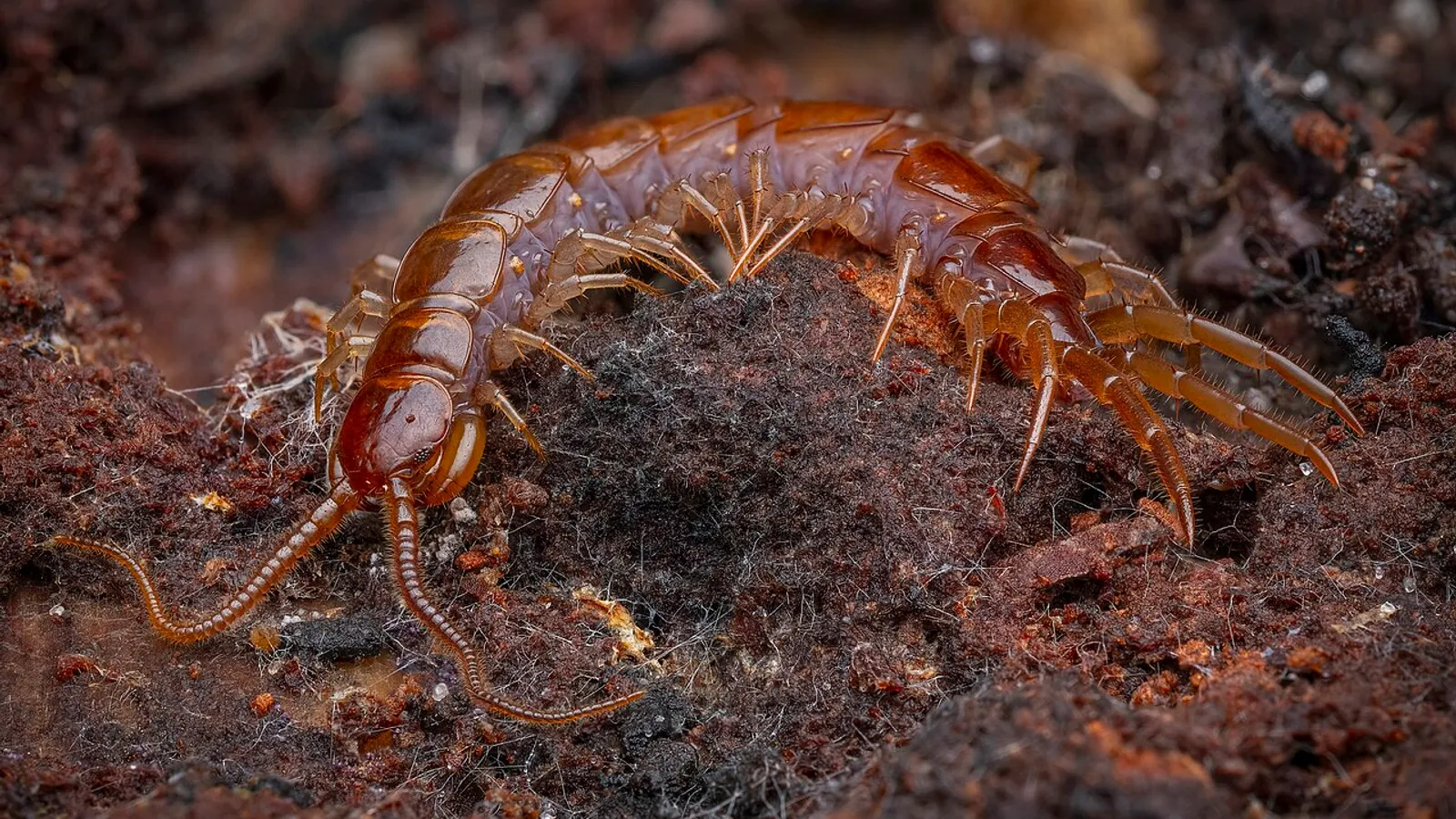
— Where the name comes from
Lithobius is “that lives under stones”, from líthos, the stone, and bíos, life: which is exactly where it is found on lifting a rock in the garden. Forficatus means “scissor-shaped”, for the curved venomous forcipules beneath the head. The name joins the place and the weapon, and that is all one needs to know about this animal.
— Facts
- Group
- Myriapods · Myriapoda
- Order
- Stone centipedes
- Habitat
- Under stones, logs and dead leaves, in gardens and woods
- Range
- Europe; introduced to North America
- Size
- 18–30 mm
- Diet
- Insects, mites, springtails, small earthworms
- Lifespan
- 5–6 years
— Characteristics
- 01
It has fifteen pairs of legs, not a hundred.
- 02
It hatches with seven pairs and adds more at each moult.
- 03
It runs very fast and flees the light the moment its shelter is lifted.
— What sets it apart
It is not born with the number of legs it will have. It leaves the egg with seven pairs and adds more at every moult until it reaches fifteen, which is the final number for every adult of its species: counting the legs therefore gives a young one’s age. Courtship is indirect and involves no contact — the male spins a small web of silk, deposits a drop of sperm on it and leaves; the female finds it and takes it up. Two animals that reproduce without meeting, guided only by a thread left on the ground.
