
Flathead grey mullet
Mugil cephalus
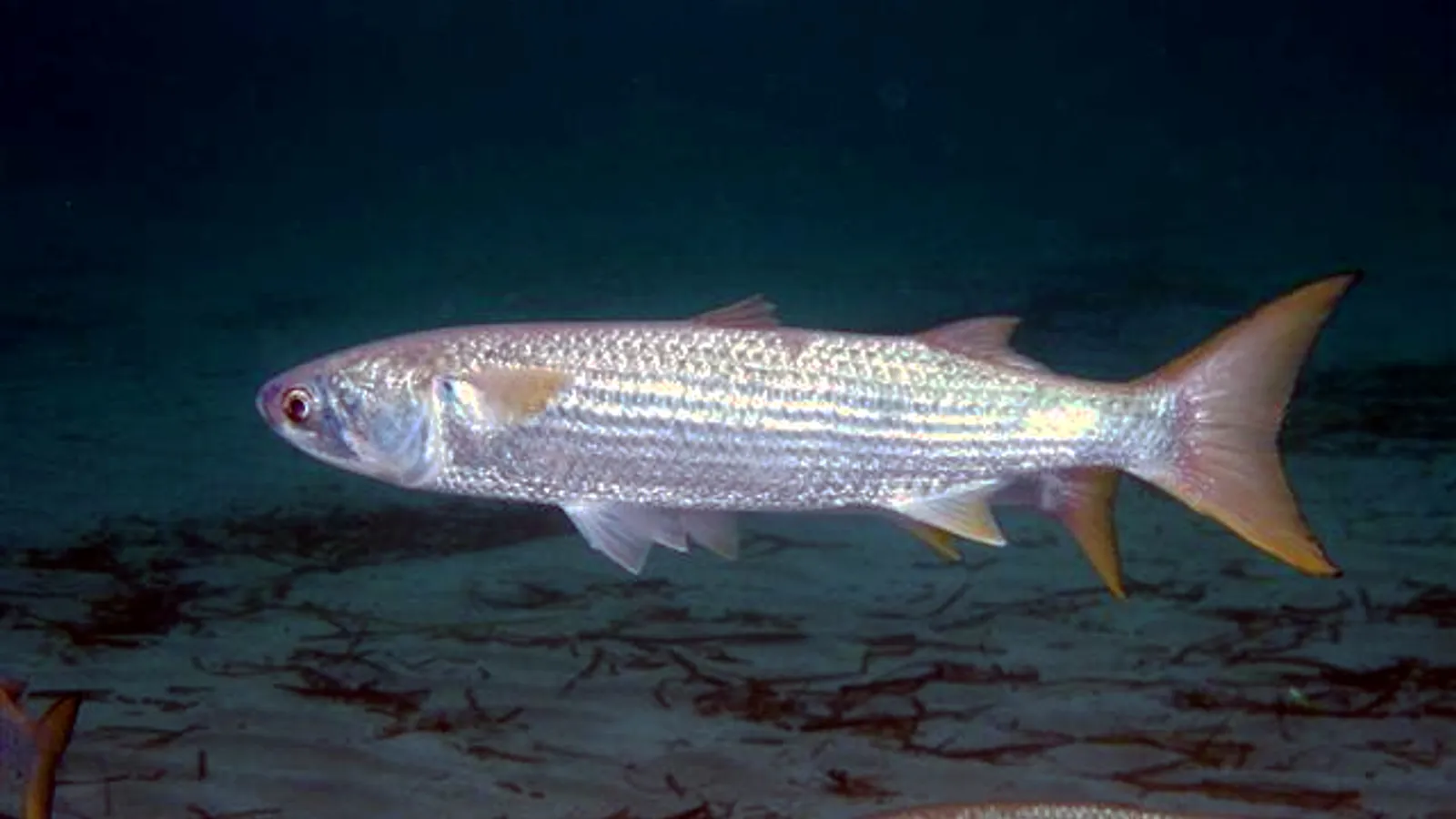
— Where the name comes from
Mugil is the Latin name of the mullet, perhaps related to mugire, to bellow; cephalus comes from the Greek kephalḗ and refers to the large flattened head. In Italian it is also called muggine, from the same Latin, and in Sardinia its salted and dried roe is bottarga, sold by weight in gold.
— Facts
- Group
- Fish · Actinopterygii · Chondrichthyes
- Order
- Mullets
- Habitat
- Estuaries, lagoons, harbours, river mouths; it also runs into fresh water
- Range
- Temperate and tropical seas worldwide
- Size
- 30–50 cm, up to 120 cm; 1–4 kg
- Diet
- Detritus, microscopic algae, bottom particles
- Lifespan
- 15 years
— Characteristics
- 01
It leaps repeatedly out of the water, often for no apparent reason.
- 02
It has a muscular stomach like a gizzard that grinds sand.
- 03
It tolerates fresh, salt and polluted water with equal indifference.
— What sets it apart
It eats mud, and its stomach is built for it. It swallows the surface sediment of the bottom, digests the algae and bacteria in it and grinds the rest in a muscular gizzard functionally identical to a chicken’s, grit and all: it is one of very few fish that feed directly on detritus, that is on the lowest rung of the food chain. That makes it both extremely abundant in lagoons and an accumulator of whatever is in the mud, including things that should not be.
