
Malagasy giant chameleon
Furcifer oustaleti
— Where the name comes from
Furcifer in Latin means “fork-bearer”, and was an insult aimed at punished slaves made to carry a wooden yoke on the neck; applied to chameleons it alludes to the forked bony structures of the head. Oustaleti recalls Émile Oustalet, zoologist at the Paris natural history museum. It is the largest chameleon in the world.
— Facts
- Group
- Reptiles · Reptilia
- Order
- Squamates
- Habitat
- Dry forest, scrub, gardens and farmland of Madagascar
- Range
- Madagascar, over most of the island
- Size
- 50–68 cm including the tail, 200–400 g
- Diet
- Large insects, small birds and reptiles
- Lifespan
- 5 years
— Characteristics
- 01
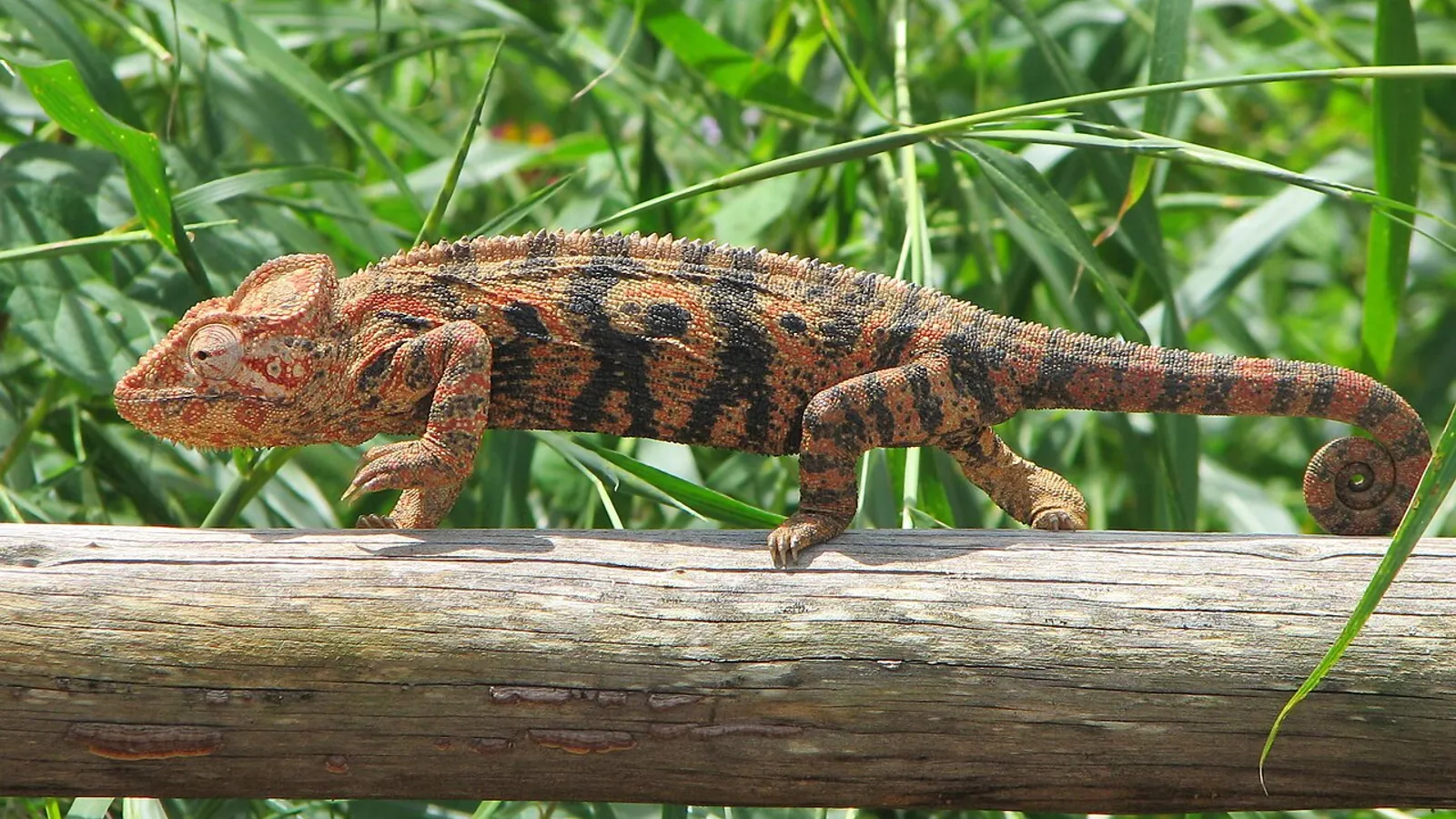
It walks rocking back and forth, like a leaf moved by the wind.
- 02
The prehensile tail curls into a spiral when not in use.
- 03
It tolerates gardens and towns better than any other Malagasy chameleon.
— What sets it apart
The tongue goes off like a whipcrack and needs no warm muscles to do it. Elastic tissue wrapped around the hyoid bone is loaded slowly and then released at once, like a stretched rubber band: the acceleration exceeds fifteen hundred times gravity and the prey is reached in under a hundredth of a second. Because the energy is stored rather than produced on the spot, the chameleon can strike with the same force early in the morning, when it is still cold and any muscle would be slow.
