Bobolink
Dolichonyx oryzivorus
— Where the name comes from
Dolichonyx joins the Greek dolichós, “long”, and ónyx, “claw”, for its very long hind claw. Oryzivorus means “rice-eater”, from oryza: on autumn migration the flocks stopped in the rice fields of South Carolina. Bobolink imitates its bubbling song, which settlers wrote down as “Bob o’ Lincoln”.
— Facts
- Group
- Birds · Aves
- Order
- Passerines
- Habitat
- Hay meadows and tall-grass prairie; pampas in winter
- Range
- Breeds in North America; winters in South America, mainly Argentina and Bolivia
- Size
- 16–18 cm, 29–56 g
- Diet
- Insects and seeds in summer, rice and grass seeds on migration
- Lifespan
- A few years
— Characteristics
- 01
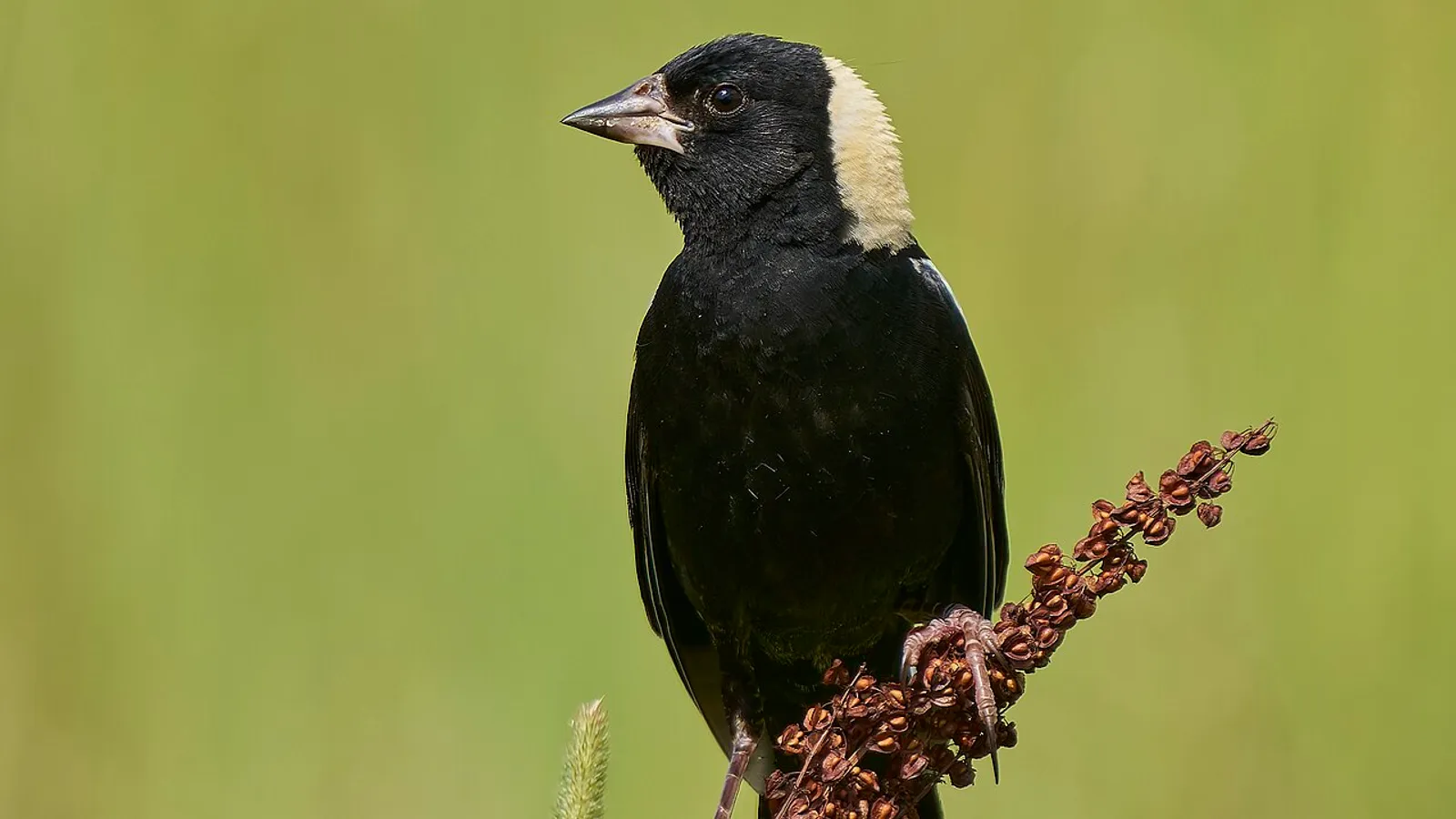
In spring the male is black below and pale above, with a straw-coloured nape: evening dress worn back to front.
- 02
After breeding it moults and turns yellowish-brown like the female.
- 03
Every year it travels some twenty thousand kilometres there and back.
— What sets it apart
It is one of the most tenacious migrants among songbirds, and one of the most studied for understanding how they orient themselves. In the 1980s experiments showed that bobolinks sense the Earth’s magnetic field and use it as a compass, and magnetite, an iron oxide sensitive to magnetism, was found in their tissues. In the nineteenth century it was a scourge for rice growers in the southern United States, who killed it by the million and sold it as “ricebird”; today it suffers instead from the early mowing of the meadows where it nests.