
Western honey bee
Apis mellifera
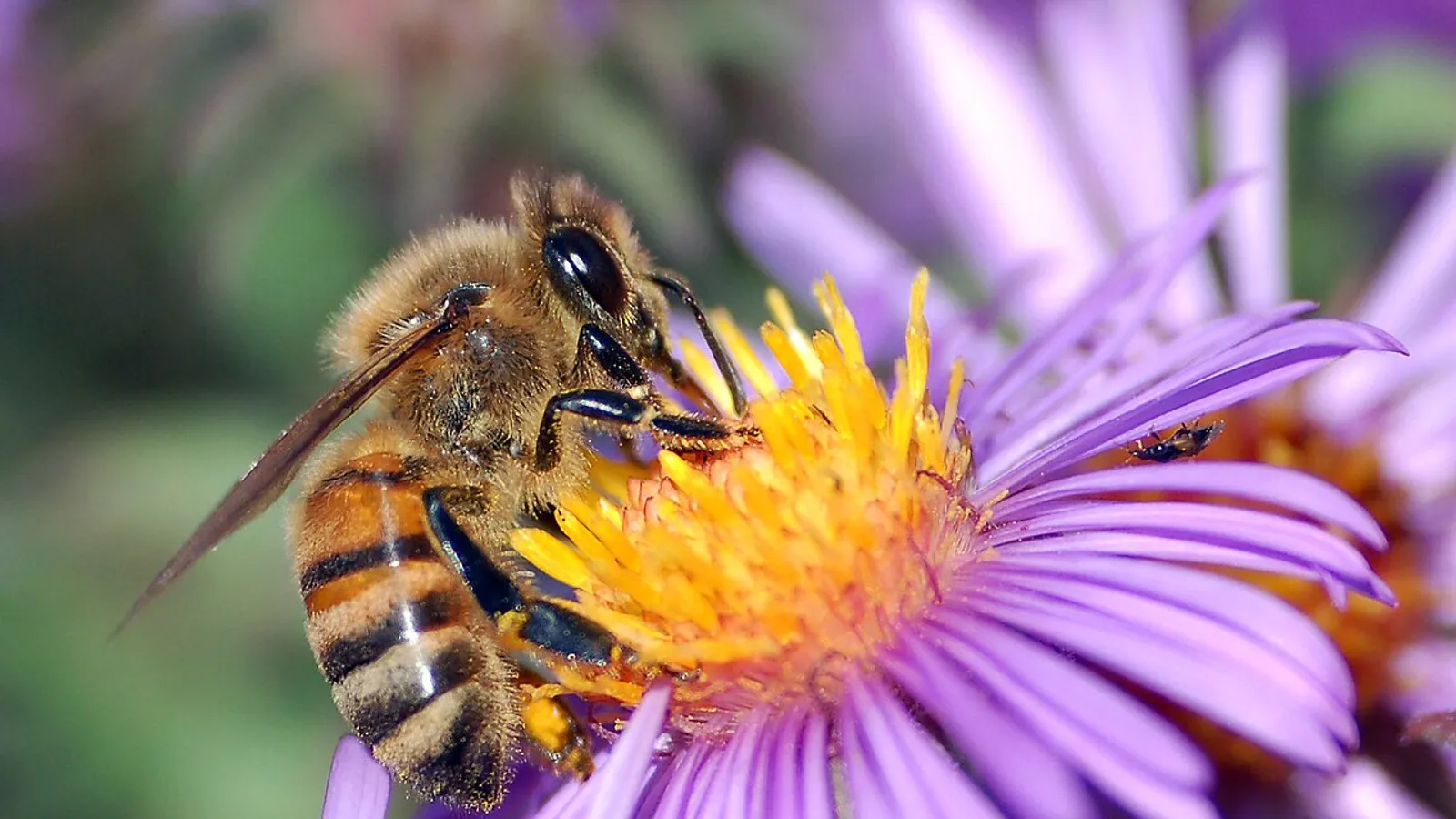
— Where the name comes from
Apis is the Latin for bee. Mellifera means “honey-bearing”: Linnaeus regretted it, because the bee does not carry honey, it carries nectar and makes the honey itself. He proposed the correction mellifica, but the rule of priority in scientific names ruled against him. The name stays wrong by law.
— Facts
- Group
- Insects · Insecta
- Order
- Bees, wasps and ants
- Habitat
- Anywhere there are flowers: woodland, meadow, farmland, city
- Range
- Native to Europe, Africa and western Asia; today worldwide
- Size
- 12–15 mm for the worker
- Diet
- Nectar and pollen
- Lifespan
- 6 weeks for a summer worker, 3–5 years for the queen
— Characteristics
- 01
A eusocial colony: one queen, tens of thousands of sterile workers, a few drones.
- 02
The hexagonal cells are the geometry that closes a plane with the least possible wax.
- 03
It sees ultraviolet and does not see red.
— What sets it apart
A forager returning to the hive dances a figure of eight. The angle of the axis against the vertical of the comb gives the angle of the food against the sun; the length of the straight run encodes the distance. It is an abstract symbolic language: it communicates a place the listener cannot see, correcting for the position of a sun that nobody in the dark hive can look at. Karl von Frisch received the Nobel Prize for it.
