
Green anaconda
Eunectes murinus
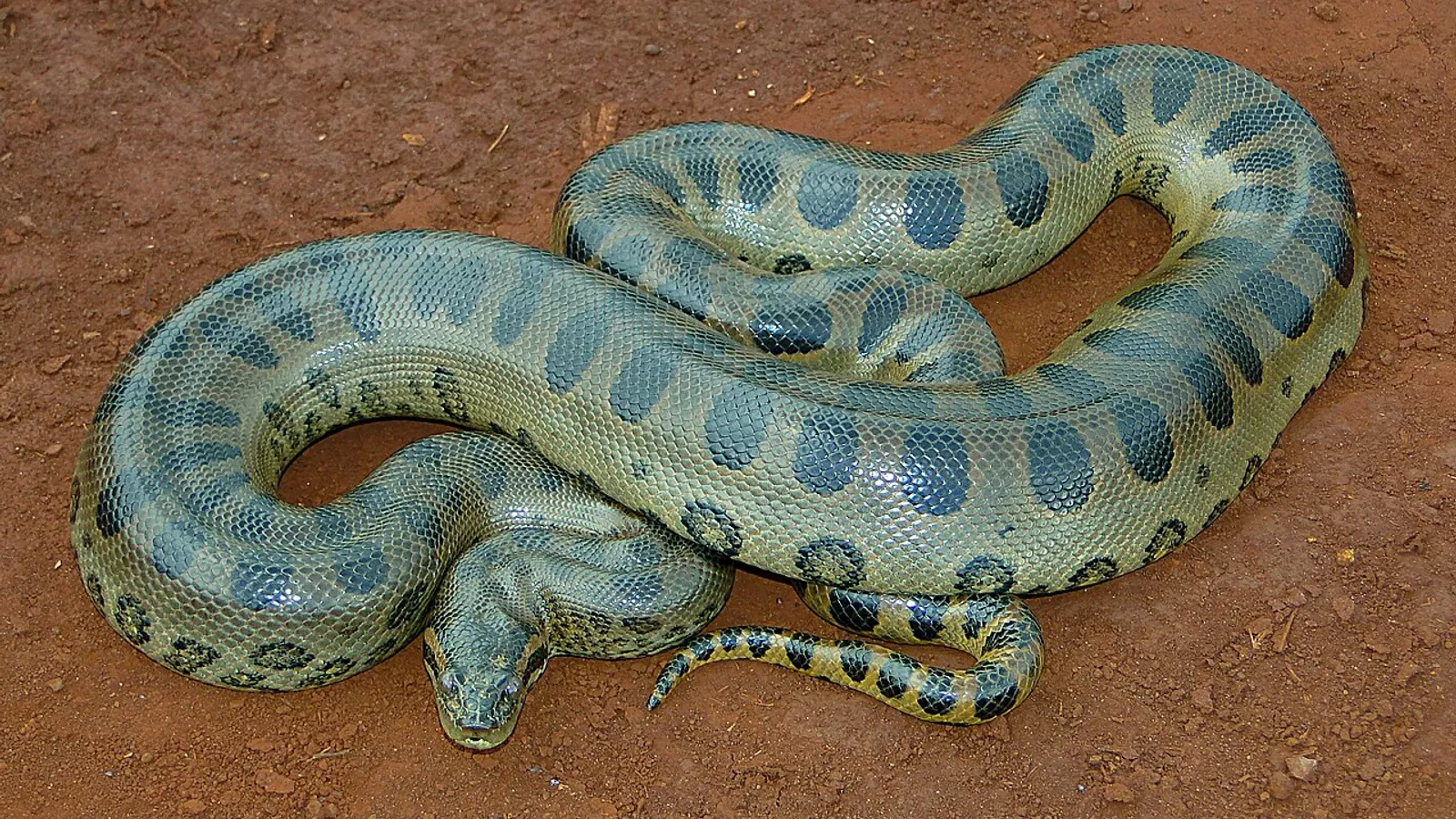
— Where the name comes from
Eunectes is Greek for “good swimmer”, from eu-, well, and nēktḗs, swimmer: its life is in the water. Murinus, from the Latin mus, “mouse”, perhaps for the colour or the prey. “Anaconda” is of uncertain origin, perhaps from the Sinhala henakandaya, “lightning snake”, later applied to the South American giant. It is the heaviest snake in the world.
— Facts
- Group
- Reptiles · Reptilia
- Order
- Squamates
- Habitat
- Swamps, slow rivers, rainforest marshes
- Range
- The Amazon and Orinoco basins, South America
- Size
- 4–6 m, with 5 m more usual, over 90 kg
- Diet
- Carnivore — capybara, caimans, deer, fish
- Lifespan
- 10–12 years
— Characteristics
- 01
It is the most massive snake on the planet, though not the longest (that record goes to the reticulated python).
- 02
Eyes and nostrils on top of the head let it lie almost entirely submerged in ambush.
- 03
The female is far larger than the male and can engulf him in breeding aggregations.
— What sets it apart
The anaconda is so heavy that on dry land it struggles to move: water is its element, because it carries the bulk and lets the snake glide and seize prey the size of a capybara or a young caiman. In the mating season several males wrap themselves around a single female in a tangle, the “breeding ball”, which can last for weeks. The female, far larger, sometimes devours her partner at the end — a last high-protein meal before a long gestation.
